

Introduction
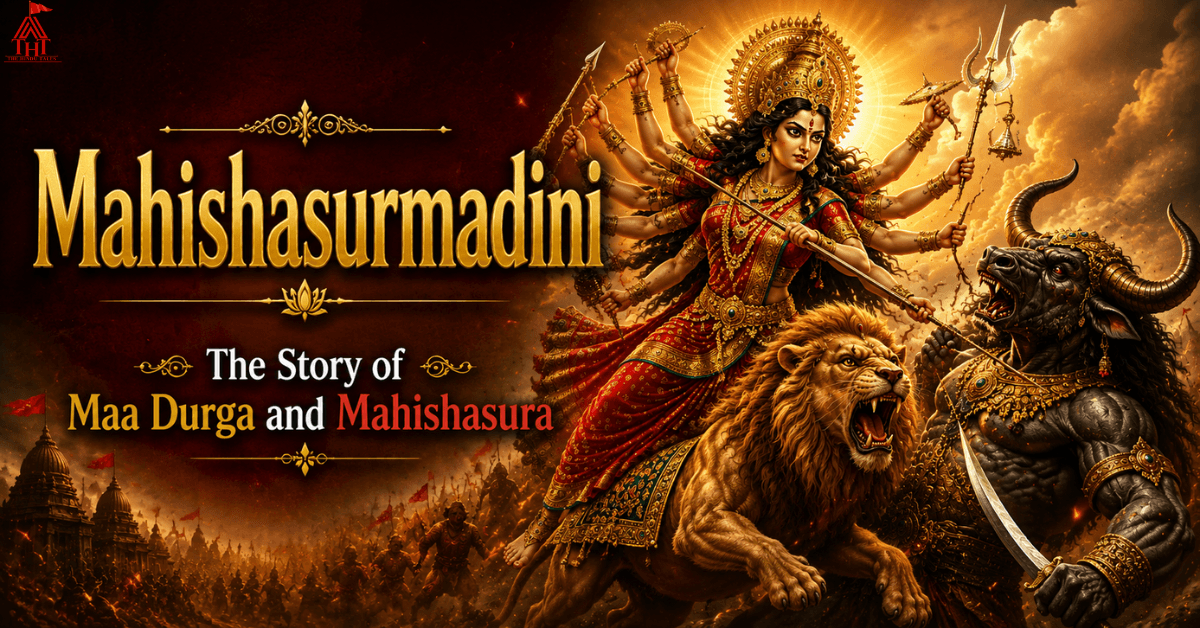
‘Mahishasurmarini’ means ‘one who slayed Mahishasur and relieved the innocents from the atrocities of Mahishasur’. In the ancient Hindu scripture “Durga Saptashati” (a significant section of the ‘Markandeya Purana’), Mother Durga is described as ‘Mahishasuramardini’ – the Slayer of Demon King Mahishasura.
But, why did the goddess Durga slay ‘Mahishasur’, and how did she get the name ‘Mahishasurmardini’? Excited to know? Read this article.
Who Was Mahishasur – The Demon King?
According to the Hindu tales, in ancient times, there lived a demon named Rambha. He fell in love with a ‘Mahishi’, who was a demoness in the form of a buffalo. In Sanskrit, ‘Mahisha’ denotes a ‘male buffalo’; therefore, ‘Mahishi’ is the feminine form of the word, signifying a ‘female buffalo’.
Rambha married the ‘Mahishi’. From their union, a demon was born who possessed powers corresponding to the attributes of both his parents. He was half-buffalo and half-demon; he wielded both the inherent powers of the demon lineage and the magical illusions (Maya) of the ‘Mahishi’. He could assume the form of a demon as well as that of a buffalo. Since he embodied the characteristics of a demon alongside the physical might of a buffalo, he was named ‘Mahishasura (Mahisha + Asura).
Lord Brahma’s Boon
True to his name, lineage, and nature, Mahishasura possessed immense strength and fierce brutality. He performed intense penance to Lord Brahma, the creator of the universe. Lord Brahma, pleased with his penance, asked his wish. Thus, taking advantage of this opportunity, he asked for a boon: that no god, demon, or human male could ever slay him. By virtue of this very boon, it was destined that his end would come only at the hands of a woman, Mother Durga.
Mahishasur’s Attrocities
Upon receiving this boon, both his strength and his arrogance grew exponentially. He became convinced that he had attained immortality. Consequently, flaunting his newfound power, he challenged the gods and began to defeat them through his formidable prowess.
He seized control of “Svarga Loka” (the celestial realm) and expelled the gods from their abode. Gradually, he established his dominion over other realms as well and began to inflict tyranny upon all. The gods, sages, humans, and all other innocents suffered immensely under his atrocities. His cruelty and atrocities disrupted the cosmic balance of ‘Dharma’, and fear and unrest spread far and wide all over
The Appearance of Goddess Durga
Then, all the gods, sages, Munis, Gandharvas, Kinnaras, and innocents approached Lord Vishnu and Lord Shiva to seek their help. Upon hearing their prayers, the ‘Tridev’ became very angry.
It leads to the emergence of a tremendous radiance from within them. It was a divine energy in the form of radiance. This radiance converged and transformed into a single divine orb of light, from which the Primordial Supreme Feminine Power—the Adi Mahashakti—emerged.
Gradually, this orb of light manifested as “Mother Durga”. His appearance filled the entire universe with peace, courage, and energy.
Empowering Goddess Durga
Thereupon, all the gods bestowed their respective weapons upon her. Lord Shiva presented her with his ‘Trident’ (Trishul), Lord Vishnu with his ‘Sudarshan Chakra’, Lord Indra with his ‘Vajra’ (Thunderbolt), and the other gods, too, offered their unique weapons to her. Thereby, adorning the weapons, she became fully empowered and ready for battle. She was gracefully mounted on a lion.
The Great Battle Between Goddess Durga and Demon Mahishasura
The Goddess, adorned with the combined powers and weapons of the gods, assumed a truly formidable form. Her manifestation was so terrifying that the very sight of her birth struck fear into the hearts of the demons.
Mahishasura’s army was vast and mighty. It comprised numerous powerful demon commanders who waged war against the Goddess. Their names were –
- Chikshura
- Chamara
- Udagra
- Mahahanu
- Asiloma
- Bashkala
- Parivarita
- Bidala
- Durdhara
- Durmukha
- Karala, and others.
A fierce battle started between Mahishasura’s army and Mother Durga, which continued for several days. One after another, Mother Durga killed all of Mahishasura’s principal commanders.
Slaying of Mahishasur
Finally, when the Goddess confronted Mahishasura himself, he began to alter his form with his illusory powers (Maya). He was repeatedly changing his form from buffalo to demon. At one moment, he would transform into a buffalo, and the next, into a demon.
In this manner, he attempted to puzzle and confuse the Goddess. However, Mother Durga vigilantly saw through every one of his illusions. Finally, when Mahishasura assumed the form of a buffalo, Mother Durga pinned him down with her feet and slew him with her trident, at that very instant.
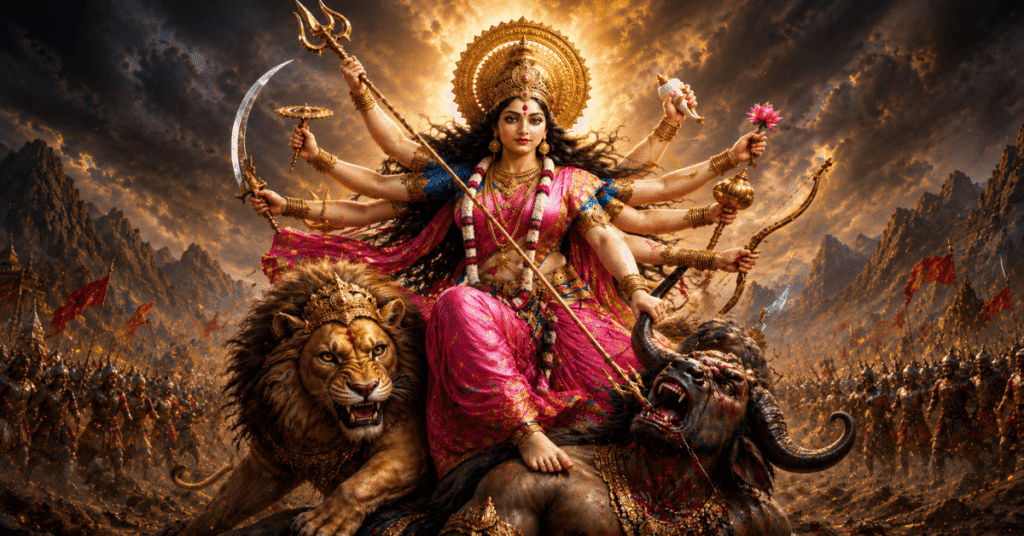
Goddess Durga Adorned The Name Mahishasurmardini
Thus, this way, the atrocities, tyranny, and cruelty of Mahishasur come to an end. Goddess Durga established the ‘Dharma’ again and assured her devotees of their protection. This is the reason why Goddess Durga is called the Ultimate Mother who is always ready to protect his children from trouble and suffering.
Following the slaying of Mahishasura, all the gods, humans, and living beings were filled with joy and happiness. They addressed her as “Mahishasuramardini,” which signifies the Goddess who slew Mahishasura, and, together, they offered hymns of praise to Mother Durga.
Mahishasurmardini Stotram
A ‘Stotram’ is a hymn of praise comprising numerous verses dedicated to a specific deity. It is different from Mantras. Whereas a ‘Mantra’ is typically a sacred sound or formula utilized for purposes such as meditation, rituals, or ceremonial rites, a hymn is just for praising.
The Mahishasuramardini Stotram is a famous Sanskrit devotional hymn dedicated to Goddess Durga in her form as Mahishasuramardini — “the Slayer of Mahishasura.” It is believed that Adi Shankaracharya was the person who composed the Mahishasurmardini Stotram. Here is the famous “Mahishasurmardini Stotram” in praise of goddess Durga:
The “Mahishasuramardini Stotram” is renowned for its role in the worship of this very valiant, divine, and benevolent form of Mother Durga. This hymn offers a deeply devotional and poetic portrayal of the Goddess’s power, beauty, valor, and her vanquishing of the demons.
The hymn is recited, in praise of the Goddess, with profound reverence and devotion, particularly during the festivals of Navaratri and Durga Puja, as well as during other occasions of Devi worship. Reciting and singing this hymn enables devotees to receive the special grace of Mother Durga, infusing them with courage, inner strength, and positive energy.
The verses of this hymn are as follows—
Ayi Girinandini Nanditamedini Vishvavinodini Nandanute
Girivara Vindhya Shiro’dhi Nivasini Vishnuvilasini Jishnunute ।
Bhagavati He Shitikanta Kutumbini Bhurikrutumbini Bhurikrute
Jaya Jaya He Mahishasuramardini Ramyakapardini Shailasute ।। 1 ।।
Suravaravarshini Durdharadharshini Durmukha Marshini Harsharate
Tribhuvanaposhini Shankaratoshini Kalmasha Moshini Ghosharate ।
Danujaniroshini Ditisutaroshini Durmadashoshini Sindhusute
Jaya Jaya He Mahishasuramardini Ramyakapardini Shailasute ।। 2 ।।
Ayi Jagadamba Madamba Kadamba Vanapriyavasini Hasarate
Shikhari Shiromani Tunga Himalaya Shringa Nijalaya Madhyagate ।
Madhumadhure Madhukaitabha Ganjini Kaitabha Bhanjini Rasarate
Jaya Jaya He Mahishasuramardini Ramyakapardini Shailasute ।। 3 ।।
Ayi Shatakhand Vikhanda Runda Vitundita Shunda Gajadhipate
Ripugajaganda Vidarana Chanda Parakramashunda Mrigadhipate ।
Nijabhujadanda Nipatita Khanda Vipatita Mundabhatadhipate
Jaya Jaya He Mahishasuramardini Ramyakapardini Shailasute ।। 4 ।।
Ayi Ranadurmada Shatruvadhodita Durdhara Nirjara Shaktibhrute
Chatura Vichara Dhurina Mahashiva Dutakruta Pramathadhipate ।
Duritaduriha Durashaya Durmati Danavaduta Krutantamate
Jaya Jaya He Mahishasuramardini Ramyakapardini Shailasute ।। 5 ।।
Ayi Sharanagata Vairivadhuvara Viravarabhaya Dayakare
Tribhuvana Mastaka Shulavirodhi Shirodhikrutaamala Shulakare ।
Dumidumitaamara Dundubhinada Mahomukharikruta Tigmakare
Jaya Jaya He Mahishasuramardini Ramyakapardini Shailasute ।। 6 ।।
Ayi Nijahunkriti Matra Nirakruta Dhumravilochana Dhumrashate
Samaravishoshita Shonitabija Samudbhava Shonita Bijalate ।
Shiva Shiva Shumbha Nishumbha Mahahava Tarpita Bhuta Pishacharate
Jaya Jaya He Mahishasuramardini Ramyakapardini Shailasute ।। 7 ।।
Dhanuranusanga Ranakshanasanga Parisphuradanga Natatkatake
Kanaka Pishanga Prushatkanishanga Rasadbhatashringa Hatavatuke ।
Krutachaturanga Balakshitiranga Ghatabahuranga Ratabatuke
Jaya Jaya He Mahishasuramardini Ramyakapardini Shailasute ।। 8 ।।
Suralalana Tatatheyi Tatheyi Krutabhinayodara Nrityarate
Kruta Kukuthah Kukutho Gadadadika Tala Kutuhala Gaanarate ।
Dhudhukuta Dhukkuta Dhindhimita Dhvani Dhira Mridanga Ninadarate
Jaya Jaya He Mahishasuramardini Ramyakapardini Shailasute ।। 9 ।।
Jaya Jaya Japyajaye Jaya Shabda Parastuti Tatpara Vishvanute
Bhana Bhanabhinjimi Bhitanupura Sinjitamohita Bhutapate ।
Natitanatardha Natinatanayaka Natitanatya Sugaanarate
Jaya Jaya He Mahishasuramardini Ramyakapardini Shailasute ।। 10 ।।
Ayi Sumanah Sumanah Sumanah Sumanah Sumanohara Kantiyute
Shritarajani Rajani Rajani Rajani Rajanikara Vaktravrute ।
Sunayanavibhramara Bhramara Bhramara Bhramara Bhramaradhipate
Jaya Jaya He Mahishasuramardini Ramyakapardini Shailasute ।। 11 ।।
Sahitamahahava Mallamatallika Mallitarallaka Mallarate
Virachitavallika Pallikamallika Bhillikabhillika Vargavrute ।
Sitakrutaphulla Samullasitaruna Tallaja Pallava Sallalite
Jaya Jaya He Mahishasuramardini Ramyakapardini Shailasute ।। 12 ।।
Avirala Ganda Galanmadamedura Matta Matangaja Rajapate
Tribhuvana Bhushana Bhuta Kalanidhi Rupapayonidhi Rajasute ।
Ayi Sudatijana Lalasa Manasa Mohana Manmatha Rajasute
Jaya Jaya He Mahishasuramardini Ramyakapardini Shailasute ।। 13 ।।
Kamaladalāmala Komalakanti Kalākalitāmala Bhālalate
Sakala Vilāsa Kalānilaya Krama Kelichalatkala Hamsakule ।
Alikula Sakula Kuvalaya Mandala Maulimilad Bhakulālikule
Jaya Jaya He Mahishasuramardini Ramyakapardini Shailasute ।। 14 ।।
Karamuralirava Vijita Kujita Lajjita Kokila Manjumate
Milita Pulinda Manohara Gunjita Ranjita Shaila Nikunjagate ।
Nijaguna Bhuta Mahashabarigana Sadgunasambhruta Kelitale
Jaya Jaya He Mahishasuramardini Ramyakapardini Shailasute ।। 15 ।।
Katitatapita Dukulavichitra Mayukha Tiraskruta Chandraruche
Pranatasuraasura Maulimani Sphuradanshulasannakha Chandraruche ।
Jitakanakachala Maulipadorjita Nirbharakunjara Kumbhakuche
Jaya Jaya He Mahishasuramardini Ramyakapardini Shailasute ।। 16 ।।
Vijita Sahasra Karaika Sahasra Karaika Sahasra Karaikanute
Krutasurataraka Sangarataraka Sangarataraka Sunusute ।
Surathasamadhi Samanasamadhi Samadhi Samadhi Sujatarate
Jaya Jaya He Mahishasuramardini Ramyakapardini Shailasute ।। 17 ।।
Padakamalam Karunanilaye Varivasyati Yo’nudinam Sa Shive
Ayi Kamale Kamalanilaye Kamalanilayah Sa Katham Na Bhavet ।
Tava Padameva Param Padamityanu Shilayato Mama Kim Na Shive
Jaya Jaya He Mahishasuramardini Ramyakapardini Shailasute ।। 18 ।।
Kanakalasat Kala Sindhujalairanu Sinchinute Guna Rangabhuvam
Bhajati Sa Kim Na Shachikuchakumbha Tatiparirambha Sukhanubhavam ।
Tava Charanam Sharanam Karavani Natamaravani Nivasi Shivam
Jaya Jaya He Mahishasuramardini Ramyakapardini Shailasute ।। 19 ।।
Tava Vimalendukulam Vadanendumalam Sakalam Nanukoolayate
Kimu Puruhuta Purindumukhi Sumukhibhirasau Vimukhikriyate ।
Mama Tu Matam Shivanamadhane Bhavati Krupaya Kimuta Kriyate
Jaya Jaya He Mahishasuramardini Ramyakapardini Shailasute ।। 20 ।।
Ayi Mayi Dinadayalutaya Krupayaiva Tvaya Bhavitavyamume
Ayi Jagato Janani Krupayasi Yathasi Tathanumitasirate ।
Yaduchitam Atra Bhavatyurari Kurutadurutapamapakurutte
Jaya Jaya He Mahishasuramardini Ramyakapardini Shailasute ।। 21 ।।
॥ Iti Shri Mahishasuramardini Stotram Sampurnam ॥
Conclusion
Thus, by slaying Mahishasura, goddess Mahishasurmardini conveyed the message that a woman is not weak, but rather the very embodiment of power. Every woman is an integral part of the ‘Jagatjanani’ (Mother of the Universe)—the Primordial Supreme Power—capable of eradicating unrighteousness and arrogance whenever the need arises.
Frequently Asked Questions (FAQs)
Q1. Who is Mahishasurmardini?
Ans. Goddess Durga or Maa Durga is often regarded as ‘Mahishasurmardini’. This is because she slew the demon king ‘Mahishasur’ and relieved the innocents from the atrocities of Mahishasur.
Q2. What is Mahishasurmardini Stotram?
Ans. Mahishasurmardini Stotram is a Sanskrit hymn famous for praising goddess Durga in her very valiant, divine, and benevolent form. It was composed by ‘Adi Shankaracharya’ and consists of 21 shlokas.
Q3. Which Demon goddess Durga killed as Mahishasurmardini?
Ans. Mahishasur, the son of Rambha, and Mahishi, was a cruel demon king whom the goddess Durga killed to end his atrocities. When Mahishasura assumed the form of a buffalo, Mother Durga pinned him down with her feet and slew him with her trident, at that very instant.
