

Introduction
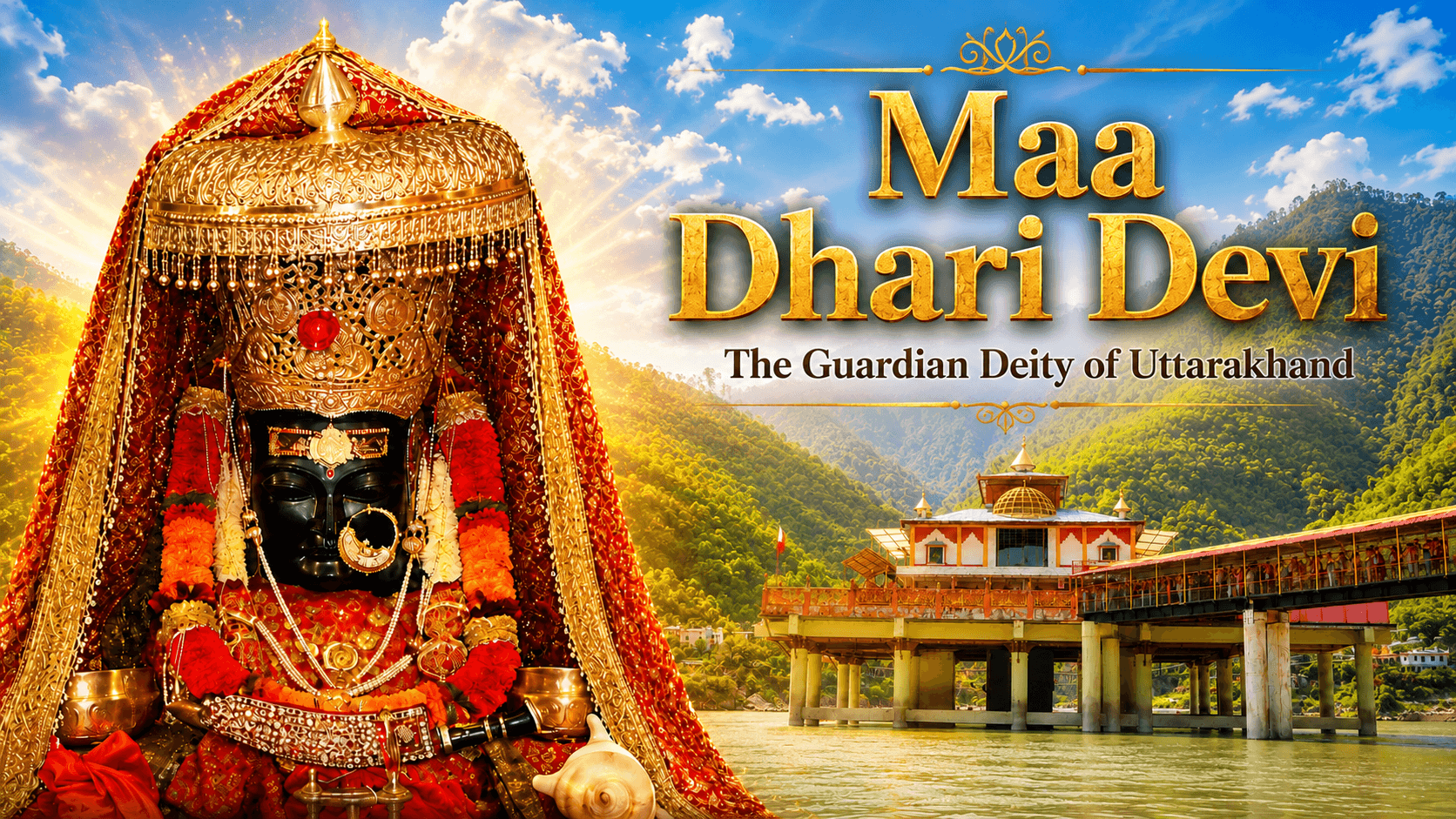
In Uttarakhand, a northern state of India, people usually believe that the submergence of this Maa Dhari Devi temple will lead to the devastation of all of Uttarakhand. But is this claim true or just a superstition? Well, no one can answer yes or no
Because in 2013, when a disturbance was made with the temple and Maa Dhari Devi idol, Uttarakhand witnessed one of its greatest tragedies in Kedarnath.
It took many lives, shook the whole nation, and raised serious questions in front of the world: Is there a connection between this temple and the 2013 Kedarnath tragedy? Was this Kedarnath Tragedy the outcome of Maa Dhari Devi’s anger? What exactly is the mystery behind this temple? and many more.
So, in this article, we will try to understand the very significance of Maa Dhari Devi for Uttarakhand. We will learn who Maa Dhari Devi is. Why is it mandatory to visit this temple before heading on to the Char Dham Yatra in Uttarakhand? And why is she known as the Guardian of Devbhoomi (Uttarakhand)? So, stay tuned and read up to the last line.
Maa Dhari Devi Temple
Uttarakhand is a place in India which is significantly known as Devbhoomi: the Land of Gods — where deities reside, from where the Mokshadayani – Maa Ganga, originates, and where the people are so devoted and spiritual.
It is a land where Lord Shiva, in the form of Kedar, permeates every particle of existence, and where the earth itself serves as the divine, transcendental abode of Lord Vishnu in the form of Shri Badrinath.
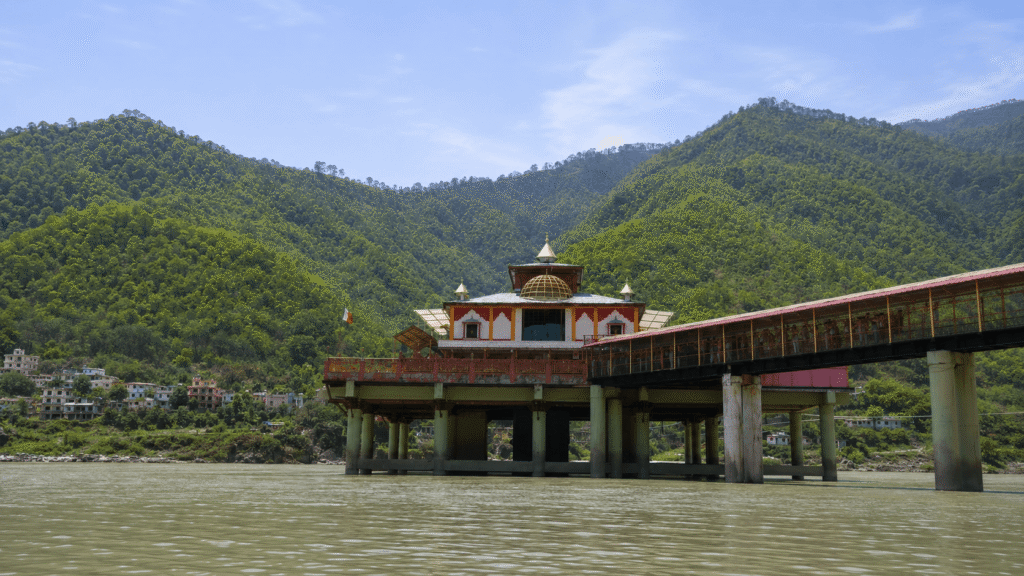
In this very Uttarakhand, in the Pauri Garhwal district of it, between Srinagar and Rudraprayag, a divine temple is situated right in the middle of the holy River Alaknanda. To an unknown or unfamiliar person, the temple may look like an ordinary one, but for the locals, it is the abode of a divine power revered as the guardian of all Uttarakhand. That divine power is Maa Dhari Devi, and this is her sacred temple.
The Story of Appearing Maa Dhari Devi Idol
It is believed that many years ago, a massive flood surged through the Alaknanda River. Amidst the floodwaters, a huge idol in the form of a boulder drifted along and came to a halt near Dharo village. That night, the villagers heard a divine voice. In that divine voice, the Mother Goddess commanded the villagers:
“Install me at this very spot and worship me.”
The villagers obeyed the Goddess’s command and installed her idol at that exact location. Gradually, this place became a focal point of faith for the entire region of Uttarakhand. Since the Mother Goddess chose Dharo village as her abode, she came to be known as ‘Dhari Devi‘.
Surrounded by the towering Himalayas, with the waters of the Alaknanda flowing below, Maa Dhari Devi sits enshrined in the midst of it all. At first glance, it appears to be an ordinary temple, but the centuries-old beliefs and the mysteries surrounding it make this Maa Dhari Devi Temple one of the most unique temples in Uttarakhand.
Who is Maa Dhari Devi? – Her Form and Manifestation
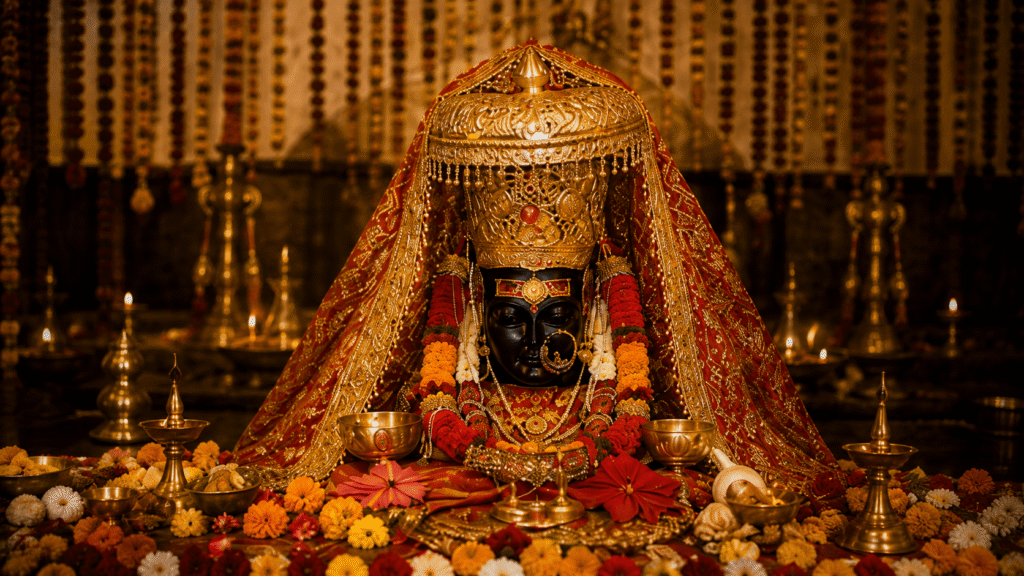
In Uttarakhand, Maa Dhari Devi is revered as a guardian force rather than merely a divine power. It is believed that Maa Dhari Devi is a manifestation of Maa Kali; hence, she is worshipped as a divine embodiment of Maa Adi Shakti (the Primal Energy).
In Maa Dhari Devi Temple, the upper part of the Goddess’s body is worshipped, while the lower part is worshipped at the KalimathTemple, located a short distance away from the Dhari Devi Temple.
The Kalimath Temple is situated in Rudraprayag, at a short distance from Srinagar. Thus, together, these two temples represent the complete power of the Goddess, and both sites are counted among the significant “Shaktipeethas (sacred places of divine feminine energy)” of Uttarakhand.
For centuries, it has been a tradition in Uttarakhand to seek the Goddess’s blessings before undertaking any auspicious task, a new journey, or a significant decision. The sole reason for this is the unwavering faith devotees have in the Goddess. They believe that she is always ready to protect her devotees and guide them in their difficult times.
The Mystery of Changing Maa Dhari Devi Idol
The devotees who visited the temple tell about the miracle of the temple. They say that the Goddess’s idol changes its appearance three times a day. Devotees believe that Maa Dhari Devi reveals herself to them in three distinct forms. In the morning, the Goddess appears as a young girl. By afternoon, her form shifts to that of a young woman, and by evening, she appears as an elderly woman.
So whether you call it a miracle or a mystery, the changing form of Maa Dhari Devi idol instills a firm belief in devotees that the Goddess’s blessings are with them at every moment.
Maa Dhari Devi As The Guardian Deity of Uttarakhand
In Uttarakhand, it locates major Hindu pilgrimages that in Hinduism are considered very sacred. Kedarnath, Badrinath, Gangotri, and Yamunotri are such revered pilgrimages in Uttarakhand, which are known as the ‘Chota Char Dham’ of Uttarakhand. Visiting these pilgrimages holds so much significance for Hindus.
But the journey to these pilgrimages in Uttarakhand is the most arduous and challenging, as the routes leading to them are known to be among the toughest and most treacherous in India. It involves the challenges of steep ascents, winding roads, single-lane paths, the risk of landslides, and the terrifying prospect of plunging into deep ravines. All these challenges combine to make the Char Dham pilgrimage a risky and adventurous undertaking.
However, when devotees have faith and the blessings of Maa Dhari Devi, fear and doubt disappear. That is why devotees, before starting the Char Dham Journey in Uttarakhand, seek the blessings of Maa Dhari Devi and pray for the successful completion of their sacred journey.
Because Maa Dhari Devi is revered as the guardian deity of Uttarakhand and protects all pilgrimage sites in Uttarakhand, especially Chota Char Dham, the journey is incomplete without her blessings. The local people believe that the goddess protects all of Uttarakhand from any calamity and thus she must not be displeased in any way.
The Wrath of Goddess Dhari Devi and the 2013 Kedarnath Tragedy
But in 2013, something occurred that seemingly enraged Goddess Dhari Devi, and the entire nation witnessed a scene that no one had ever even imagined. In 2013, Uttarakhand witnessed one of the most devastating natural disasters in its history. It proved to be a horrific tragedy not only for Uttarakhand but also for the nation, and seemed to be unbelievable, unimaginable, miraculous, and spine-chilling to everyone.
Thousands of lives were lost, and the Kedarnath region suffered massive devastation. But the Kedarnath Dham—the abode of Lord Kedar—remained completely safe, and those who had taken shelter inside the Kedarnath temple that night were protected from this terrible calamity.
The Kedarnath Tragedy 2013
Date: June 16, 2013
Time: Approximately 11:00 AM
Location: Srinagar, Uttarakhand
Alaknanda Hydro Power Company Ltd. (AHPCL) intended to relocate the idol of the ancient Goddess Dhari Devi temple—situated on the banks of the Alaknanda River—from its original site to a higher platform as part of the Alaknanda Hydroelectric Project. However, locals and devotees believed that Goddess Dhari Devi was the guardian of Uttarakhand and therefore warned that moving the idol from its original location could be inauspicious and might invite a major calamity upon the region.
The officials and staff associated with the project disregarded the concerns of the locals.
And at approximately 6:30 PM, they installed the upper portion of the idol at the new location.
But, within just one hour of the idol being moved, as evening began to set in, the mood of the sky over Uttarakhand started to change. Dense clouds began to envelop the mountains, and the towering peaks seemed to vanish into the mist as if signaling an impending calamity and refusing to witness the unfolding tragedy.
From around 8 PM, continuous rain began to lash the mountains. Initially, people mistook it for ordinary monsoon rainfall. But, even after several hours, the rain showed no signs of stopping.
By around 11 PM, the water levels in the rivers began to rise steadily due to the incessant rain across the Kedarnath Valley, Gaurikund, Rambara, and surrounding areas.
Most pilgrims resting in their hotels, guesthouses, and camps were completely unaware of the catastrophe nature was about to unleash upon them.
The next day, on June 17, 2013, by around 3 AM, the rain had intensified further. The once-calm Mandakini River’s sound changed, and its roar could now be heard from afar. The commotion woke people up; terrified, they gazed at Mandakini’s ferocious new form.
And around 6 AM, the relentless rain caused the natural dam of Chorabari Lake—situated above Kedarnath—to breach. Thousands of tons of water, rocks, ice, and debris began rushing downwards with immense velocity.
Within minutes, this destructive torrent reached the Kedarnath Valley. The enraged Mandakini River seemed bent on sweeping everything away in its path.
Screams and cries filled the air…
Buildings collapsing…
Vehicles being washed away…
And massive boulders hurtling down amidst the debris…
In mere moments, the entire valley had transformed into a scene of watery devastation. But amidst this horrific devastation, the Kedarnath Dham witnessed a miraculous sight that no one had ever imagined.
As water, boulders, and heavy debris surged rapidly toward the Kedarnath temple, it seemed impossible for the shrine to survive. The destructive torrent of the Mandakini River was sweeping away everything in its path.
But then…A massive boulder, carried down from the upper hills, came to a halt right behind the temple. This huge rock split the oncoming debris and the main force of the water—which would have otherwise struck the temple directly—into two separate streams.
Consequently, the water, flowing with destructive velocity, bypassed the temple on both sides.
Most of the buildings, pilgrim rest houses, and structures surrounding the temple complex were destroyed in this deluge. Yet, the centuries-old Kedarnath temple remained steadfast and unshaken. This served as proof that although Maa Dhari Devi was enraged, she did not allow the Kedarnath temple to be harmed; instead, she protected it.
Later, this rock was named “Bhim Shila,” as devotees regarded it as a symbol of Lord Shiva’s grace, Maa Dhari Devi’s blessing, and the divine protection of Bhim, the son of Pandu.
To this day, this massive rock stands behind the Kedarnath temple. Every year, millions of devotees visit the rock to pay homage to that unseen power which, amidst such devastation, did not let the flame of faith be extinguished.
Devotees attributed this disaster to the Mother Goddess’s displeasure and wrath, while also expressing their gratitude to her for protecting the Kedarnath temple.
The Final Conclusion
Later, the idol of Maa Dhari Devi was reinstalled at its original location. The Maa Dhari Devi temple that we see today stands on a high platform built over the Alaknanda River at that very spot. Situated right above the river, this temple instills a sense of divinity in devotees and offers them a profound spiritual experience.
Every year, lakhs of devotees visit this place. The grandeur of the temple is further enhanced during Navratri. The temple adorned with flowers, the resonance of bells, the ceaseless flow of the Mandakini River, the cool breeze carrying the touch of the river’s waves, the chanting of mantras, and the unwavering faith of the devotees—All these elements combine to create an experience that is difficult to put into words. Yet, amidst this peace and serenity, one final question keeps recurring in the mind:
- Will the wrath of Maa Dhari Devi devastate the entire state of Uttarakhand?
- Will Uttarakhand be able to withstand the fury of Maa Dhari Devi?
- Could a tragedy like the 2013 Kedarnath disaster strike again in the future?
What are your thoughts on this? Please share your opinion in the comments.
Jai Maa Dhari Devi!
Frequently Asked Questions (FAQs)
Q1. Who is Maa Dhari Devi?
Ans. Maa Dhari Devi is one of the manifestations of Maa Kali or Adi Parashakti, who is revered as the guardian deity of Uttarakhand. Locals believe that she protects Uttarakhand and all the pilgrimages here, such as Kedarnath, Badrinath, Gangotri, Yamunotri, etc.
Q2. Where is Maa Dhari Devi Temple?
Ans. Maa Dhari Devi Temple is situated in Uttarakhand, in the Pauri Garhwal district, between Srinagar and Rudraprayag, right in the middle of the holy River Alaknanda.
Q3. What Are the Three Forms of Maa Dhari Devi?
Ans. The three forms of Maa Dhari Devi are of a child, a young woman, and an elderly woman. Devotees believe that Maa Dhari Devi reveals herself to devotees in three distinct forms. In the morning, the Goddess appears as a young girl. By afternoon, her form shifts to that of a young woman, and by evening, she appears as an elderly woman.
