

Introduction
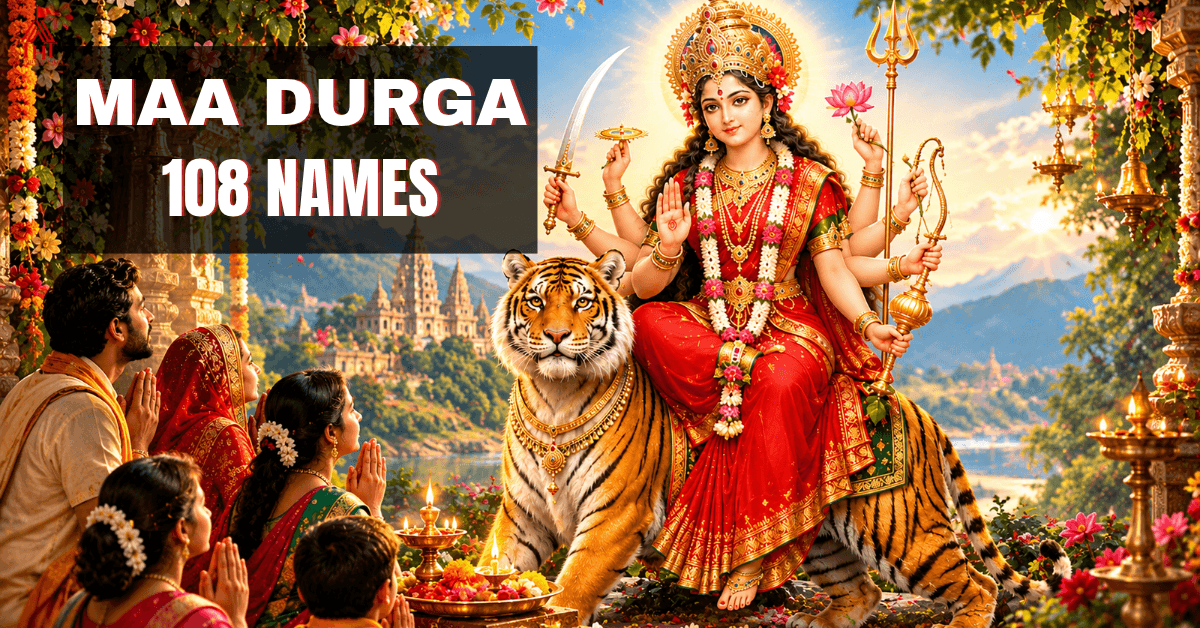
Mother Durga is the supreme maternal power, the source of all energy, the sustainer, the bestower, the creator, and the fundamental basis of life. She is primarily regarded as Ambika, Jagadambika, Adishakti, and the embodiment of supreme power. She is the divine force that protects the universe, destroys unrighteousness (adharma), and guides her devotees through fear, crises, and obstacles.
She is worshipped in many forms, and consequently, she bears many names. Various hymns, litanies, mythological narratives, and Tantric traditions reveal many names for the Goddess, but among them, the 108 names of Mother Durga hold special significance.
The “Shri Durga Dvatrinshannama Mala”—a garland of 32 names of Mother Durga—praises her specifically as a protective power, whereas the “Shri Durga Ashtottarashatanamavali”—the garland of Maa Durga 108 names—reveals her diverse forms and powers.
In these 108 names, she manifests through various divine forms, attributes, powers, relationships, weapons, acts of penance, wisdom, fierce aspects, maternal manifestations, and philosophical dimensions.
In this article, we will explore and examine the sacred list of 108 names of Mother Durga according to the “Vishvasara Tantra” tradition.
I understand now. You want the word formation on one separate bold line, followed by the component meanings and the complete explanation, exactly as in your example. Here is the complete list in that format.
Maa Durga 108 Names
Below are Maa Durga 108 names with mantras and meanings:
1. ॐ सत्यै नमः — Om Satyai Namah
Name: Satī (सती)
Satī = Sat + Ī
Sat (सत्): Truth, eternal existence, and that which is auspicious.
Ī (ई): A feminine suffix.
Meaning: Satī is the Goddess who embodies truth, purity, and eternal existence. This name is particularly associated with Goddess Satī, the daughter of Prajapati Daksha and the first consort of Lord Shiva.
2. ॐ साध्व्यै नमः — Om Sādhvyai Namah
Name: Sādhvī (साध्वी)
Sādhvī = Sādh + Vī
Sādh (साध्): Virtue, righteousness, and spiritual discipline.
Vī (वी): A feminine suffix in this name.
Meaning: Sādhvī is the virtuous and righteous Goddess who embodies purity, goodness, and unwavering devotion. She represents the highest ideals of moral conduct and spiritual discipline.
3. ॐ भवप्रीतायै नमः — Om Bhavaprītāyai Namah
Name: Bhavaprītā (भवप्रीता)
Bhavaprītā = Bhava + Prītā
Bhava (भव): Lord Shiva; also existence or worldly life.
Prītā (प्रीता): Beloved, pleased, or filled with love.
Meaning: Bhavaprītā is the Goddess who is beloved of Lord Shiva and shares an eternal bond of love with Him. The name reflects the divine relationship between Shiva and Shakti.
4. ॐ भवानी नमः — Om Bhavānyai Namah
Name: Bhavānī (भवानी)
Bhavānī = Bhava + Ānī
Bhava (भव): Lord Shiva; also the source of existence.
Ānī (आनी): A feminine name-form associated with Bhava.
Meaning: Bhavānī is the divine consort of Lord Shiva and the Mother Goddess who sustains all existence. She is revered as the universal Mother and the source of life.
5. ॐ भवमोचन्यै नमः — Om Bhavamocanyai Namah
Name: Bhavamocanī (भवमोचनी)
Bhavamocanī = Bhava + Mocanī
Bhava (भव): Worldly existence and the cycle of birth and death.
Mocanī (मोचनी): She who liberates or sets free.
Meaning: Bhavamocanī is the Goddess who liberates her devotees from worldly bondage and frees them from the cycle of birth and death. She guides souls towards spiritual liberation.
6. ॐ आर्यायै नमः — Om Āryāyai Namah
Name: Āryā (आर्या)
Āryā: A word denoting nobility, honour, and excellence.
Meaning: Āryā is the noble and revered Goddess who embodies dignity, virtue, and righteousness. She represents the highest ideals of character and divine conduct.
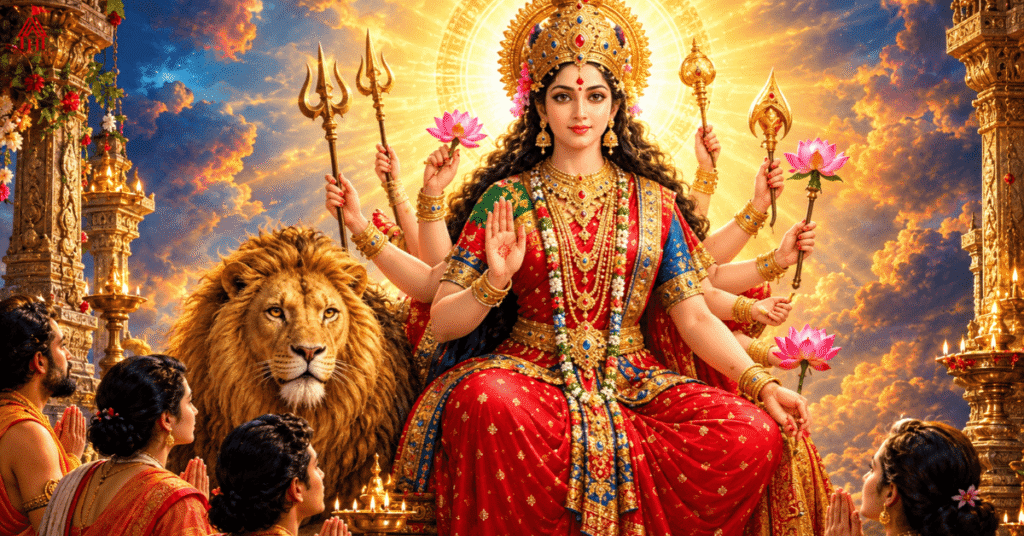
7. ॐ दुर्गायै नमः — Om Durgāyai Namah
Name: Durgā (दुर्गा)
Durgā = Dur + Gam
Dur (दुर्): Difficult or challenging.
Gam (गम्): To go, pass, or overcome.
Meaning: Durgā is the invincible Goddess who protects her devotees from difficulties and dangers. She helps beings overcome the challenges of life and guides them through the most difficult circumstances.
8. ॐ जयायै नमः — Om Jayāyai Namah
Name: Jayā (जया)
Jayā: Victory, triumph, and success.
Meaning: Jayā is the Goddess who grants victory over evil, negativity, and obstacles. She represents the ultimate triumph of righteousness and divine power.
9. ॐ आद्यायै नमः — Om Ādyāyai Namah
Name: Ādyā (आद्या)
Ādyā: The primordial, original, or first.
Meaning: Ādyā is the Goddess who existed before creation and is the original source of all existence. She is the primordial form of divine feminine energy from whom the entire universe manifests.
10. ॐ त्रिनेत्रायै नमः — Om Trinetrāyai Namah
Name: Trinetrā (त्रिनेत्रा)
Trinetrā = Tri + Netra
Tri (त्रि): Three.
Netra (नेत्र): Eye.
Meaning: Trinetrā is the three-eyed Goddess who possesses divine vision and the ability to perceive the past, present, and future. Her three eyes also symbolise the Sun, Moon, and Fire.
11. ॐ शूलधारिण्यै नमः — Om Śūladhāriṇyai Namah
Name: Śūladhāriṇī (शूलधारिणी)
Śūladhāriṇī = Śūla + Dhāriṇī
Śūla (शूल): Trident or spear.
Dhāriṇī (धारिणी): She who holds or carries.
Meaning: Śūladhāriṇī is the Goddess who carries the trident, symbolising her power to destroy evil and protect the universe. Her weapon represents divine strength and the destruction of negative forces.
12. ॐ पिनाकधारिण्यै नमः — Om Pinākadhāriṇyai Namah
Name: Pinākadhāriṇī (पिनाकधारिणी)
Pinākadhāriṇī = Pināka + Dhāriṇī
Pināka (पिनाक): The divine bow associated with Lord Shiva.
Dhāriṇī (धारिणी): She who holds or carries.
Meaning: Pinākadhāriṇī is the Goddess who bears the divine weapon Pināka, representing her immense strength and her inseparable connection with Lord Shiva.
13. ॐ चित्रायै नमः — Om Citrāyai Namah
Name: Citrā (चित्रा)
Citrā: Wonderful, extraordinary, colourful, or beautifully varied.
Meaning: Citrā is the Goddess who possesses countless remarkable forms and qualities. Her name reflects the infinite variety, beauty, and splendour of the Divine Mother.
14. ॐ चण्डघण्टायै नमः — Om Caṇḍaghaṇṭāyai Namah
Name: Caṇḍaghaṇṭā (चण्डघण्टा)
Caṇḍaghaṇṭā = Caṇḍa + Ghaṇṭā
Caṇḍa (चण्ड): Fierce, powerful, or formidable.
Ghaṇṭā (घण्टा): Bell.
Meaning: Caṇḍaghaṇṭā is the fierce Goddess whose bell resounds with divine power, frightening evil forces and protecting her devotees. She is also worshipped as the third form of Navadurga.
15. ॐ महातपायै नमः — Om Mahātapāyai Namah
Name: Mahātapā (महातपा)
Mahātapā = Mahā + Tapas
Mahā (महा): Great or supreme.
Tapas (तपस्): Austerity, penance, and spiritual discipline.
Meaning: Mahātapā is the Goddess who possesses supreme spiritual power through intense austerity and penance. Her name represents extraordinary discipline, determination, and divine energy.
16. ॐ मनरूपायै नमः — Om Manarūpāyai Namah
Name: Manarūpā (मनरूपा)
Manarūpā = Manas + Rūpā
Manas (मनस्): Mind or consciousness.
Rūpā (रूपा): Form or embodiment.
Meaning: Manarūpā is the Goddess who manifests as the mind and is present within the consciousness of all beings. She represents the divine presence behind thought and awareness.
17. ॐ बुद्धये नमः — Om Buddhaye Namah
Name: Buddhi (बुद्धि)
Buddhi: Intellect, understanding, wisdom, and discernment.
Meaning: Buddhi is the Goddess who embodies intelligence and wisdom. She enables beings to distinguish between truth and falsehood, right and wrong, and guides them towards sound judgement.
18. ॐ अहंकारायै नमः — Om Ahaṅkārāyai Namah
Name: Ahaṅkārā (अहंकारा)
Ahaṅkārā = Aham + Kāra
Aham (अहम्): I or the sense of self.
Kāra (कार): Making, creating, or forming.
Meaning: Ahaṅkārā is the Goddess associated with the principle of ego or the sense of individuality. The name also reflects the divine power behind the sense of self that operates within every living being.
19. ॐ चित्तरूपायै नमः — Om Cittarūpāyai Namah
Name: Cittarūpā (चित्तरूपा)
Cittarūpā = Citta + Rūpā
Citta (चित्त): Mind, consciousness, or inner awareness.
Rūpā (रूपा): Form or embodiment.
Meaning: Cittarūpā is the Goddess who embodies consciousness itself and resides within the innermost awareness of every being. She represents the divine essence of the mind and its capacity for spiritual awareness.
20. ॐ चितायै नमः — Om Citāyai Namah
Name: Citā (चिता)
Citā: Consciousness, awareness, or pure knowledge.
Meaning: Citā is the Goddess who embodies pure consciousness and is the source of spiritual awareness. She represents the illuminating power through which all knowledge becomes possible.
21. ॐ चित्यै नमः — Om Cityai Namah
Name: Citi (चितिः)
Citi: Pure consciousness, intelligence, and divine awareness.
Meaning: Citi is the supreme conscious energy through which the universe comes into being and is sustained. She is the eternal awareness underlying all creation.
22. ॐ सर्वमन्त्रमय्यै नमः — Om Sarvamantramayyai Namah
Name: Sarvamantramayī (सर्वमन्त्रमयी)
Sarvamantramayī = Sarva + Mantra + Mayī
Sarva (सर्व): All or everything.
Mantra (मन्त्र): Sacred sound, prayer, or divine formula.
Mayī (मयी): Consisting of or filled with.
Meaning: Sarvamantramayī is the Goddess who is present in all mantras and embodies their divine power. Every sacred invocation ultimately draws its spiritual force from her.
23. ॐ सत्तायै नमः — Om Sattāyai Namah
Name: Sattā (सत्ता)
Sattā: Existence, being, or reality.
Meaning: Sattā is the Goddess who is the very foundation of existence and the eternal reality behind everything that exists. She represents the fundamental truth of the universe.
24. ॐ सत्यानन्दस्वरूपिण्यै नमः — Om Satyānandasvarūpiṇyai Namah
Name: Satyānandasvarūpiṇī (सत्यानन्दस्वरूपिणी)
Satyānandasvarūpiṇī = Satya + Ānanda + Svarūpiṇī
Satya (सत्य): Truth or eternal reality.
Ānanda (आनन्द): Bliss or supreme joy.
Svarūpiṇī (स्वरूपिणी): She whose very nature or form is.
Meaning: Satyānandasvarūpiṇī is the Goddess whose essential nature is eternal truth and supreme bliss. She represents the highest spiritual state in which truth and divine happiness become one.
25. ॐ अनन्तायै नमः — Om Anantāyai Namah
Name: Anantā (अनन्ता)
Anantā = An + Anta
An (अन्): Without or beyond.
Anta (अन्त): End or limit.
Meaning: Anantā is the Goddess who is infinite, eternal, and without any beginning or end. Her power and existence extend beyond all limitations.
26. ॐ भाविन्यै नमः — Om Bhāvinyai Namah
Name: Bhāvinī (भाविनी)
Bhāvinī: She who brings things into being or is destined to manifest.
Meaning: Bhāvinī is the Goddess who creates, nurtures, and brings forth existence. She represents the creative potential of the Divine Mother.
27. ॐ भाव्यायै नमः — Om Bhāvyāyai Namah
Name: Bhāvyā (भाव्या)
Bhāvyā: Worthy of contemplation, reverence, and meditation.
Meaning: Bhāvyā is the Goddess who is worthy of being worshipped and meditated upon. Her divine nature inspires devotion, reflection, and spiritual understanding.
28. ॐ भवायै नमः — Om Bhavyāyai Namah
Name: Bhavyā (भव्या)
Bhavyā: Auspicious, glorious, splendid, or worthy.
Meaning: Bhavyā is the Goddess who embodies divine splendour, grace, and auspiciousness. Her presence brings goodness and prosperity.
29. ॐ अभव्यायै नमः — Om Abhavyāyai Namah
Name: Abhavyā (अभव्या)
Abhavyā = A + Bhavyā
A (अ): Without or beyond.
Bhavyā (भव्या): That which is limited or subject to worldly conditions.
Meaning: Abhavyā is the Goddess who is beyond worldly limitations and ordinary appearances. Her divine nature cannot be confined by material definitions.
30. ॐ सदागत्यै नमः — Om Sadāgatyai Namah
Name: Sadāgati (सदागति)
Sadāgati = Sadā + Gati
Sadā (सदा): Always or eternally.
Gati (गति): Path, destination, movement, or refuge.
Meaning: Sadāgati is the Goddess who is the eternal path and ultimate refuge for all beings. She guides her devotees towards liberation and the highest spiritual destination.
31. ॐ शाम्भव्यै नमः — Om Śāmbhavyai Namah
Name: Śāmbhavī (शाम्भवी)
Śāmbhavī = Śambhu + Ī
Śambhu (शम्भु): Lord Shiva, the benevolent one.
Ī (ई): A feminine suffix.
Meaning: Śāmbhavī is the divine consort of Lord Shiva, who shares His supreme consciousness and auspicious nature. She represents the divine feminine energy inseparable from Shiva.
32. ॐ देवमात्रे नमः — Om Devamātre Namah
Name: Devamātā (देवमाता)
Devamātā = Deva + Mātā
Deva (देव): Divine being or deity.
Mātā (माता): Mother.
Meaning: Devamātā is the Mother of the Gods, who nurtures and protects the divine beings and sustains the cosmic order. She is the universal Mother who cares for all creation.
33. ॐ चिन्तायै नमः — Om Cintāyai Namah
Name: Cintā (चिन्ता)
Cintā: Thought, reflection, contemplation, or concern.
Meaning: Cintā is the Goddess associated with thought and contemplation. She inspires reflection and guides the mind towards deeper understanding and spiritual awareness.
34. ॐ रत्नप्रियायै सदायै नमः — Om Ratnapriyāyai Sadāyai Namah
Name: Ratnapriyā Sadā (रत्नप्रिया सदा)
Ratnapriyā = Ratna + Priyā
Ratna (रत्न): Gem, jewel, or precious treasure.
Priyā (प्रिया): Beloved or one who is fond of.
Sadā (सदा): Always or eternally.
Meaning: Ratnapriyā Sadā is she who is eternally fond of precious jewels and divine treasures. The name also reflects her association with splendour, abundance, and auspiciousness.
35. ॐ सर्वविद्यायै नमः — Om Sarvavidyāyai Namah
Name: Sarvavidyā (सर्वविद्या)
Sarvavidyā = Sarva + Vidyā
Sarva (सर्व): All or everything.
Vidyā (विद्या): Knowledge, learning, or wisdom.
Meaning: Sarvavidyā is the Goddess who embodies all forms of knowledge and wisdom. Every branch of learning and every path of true understanding ultimately arises from her.
36. ॐ दक्षकन्यायै नमः — Om Dakṣakanyāyai Namah
Name: Dakṣakanyā (दक्षकन्या)
Dakṣakanyā = Dakṣa + Kanyā
Dakṣa (दक्ष): Prajapati Daksha.
Kanyā (कन्या): Daughter or maiden.
Meaning: Dakṣakanyā is the daughter of Prajapati Daksha, referring to Goddess Satī, who was born as Daksha’s daughter before becoming the consort of Lord Shiva.
37. ॐ दक्षयज्ञविनाशिन्यै नमः — Om Dakṣayajñavināśinyai Namah
Name: Dakṣayajñavināśinī (दक्षयज्ञविनाशिनी)
Dakṣayajñavināśinī = Dakṣa + Yajña + Vināśinī
Dakṣa (दक्ष): Prajapati Daksha.
Yajña (यज्ञ): Sacrificial ritual or sacred offering.
Vināśinī (विनाशिनी): She who destroys.
Meaning: Dakṣayajñavināśinī is the Goddess associated with the destruction of Daksha’s yajña. This name recalls the episode in which Goddess Satī gave up her body after being deeply hurt by her father’s insult towards Lord Shiva.
38. ॐ अपर्णायै नमः — Om Aparṇāyai Namah
Name: Aparṇā (अपर्णा)
Aparṇā = A + Parṇa
A (अ): Without.
Parṇa (पर्ण): Leaf.
Meaning: Aparṇā is the Goddess who did not even consume leaves during her severe penance. This name is associated with Goddess Pārvatī and reflects her extraordinary determination and devotion to Lord Shiva.
39. ॐ अनेकवर्णायै नमः — Om Anekavarṇāyai Namah
Name: Anekavarṇā (अनेकवर्णा)
Anekavarṇā = Aneka + Varṇa
Aneka (अनेक): Many or countless.
Varṇa (वर्ण): Colours, forms, or descriptions.
Meaning: Anekavarṇā is the Goddess who manifests in countless colours and forms. Her infinite manifestations reflect the diversity and vastness of the universe.
40. ॐ पाटलायै नमः — Om Pāṭalāyai Namah
Name: Pāṭalā (पाटला)
Pāṭalā: Reddish or pinkish colour, often associated with the hue of flowers.
Meaning: Pāṭalā is the Goddess whose appearance is associated with a beautiful reddish glow. The name evokes beauty, radiance, and divine splendour.
41. ॐ पाटलावत्यै नमः — Om Pāṭalāvatyai Namah
Name: Pāṭalāvatī (पाटलावती)
Pāṭalāvatī = Pāṭala + Vatī
Pāṭala (पाटल): Reddish or pinkish hue.
Vatī (वती): Possessing or adorned with.
Meaning: Pāṭalāvatī is the Goddess who is adorned with a beautiful reddish complexion or radiance, symbolising divine beauty and grace.
42. ॐ पट्टाम्बरपरिधानायै नमः — Om Paṭṭāmbaraparīdhānāyai Namah
Name: Paṭṭāmbaraparīdhānā (पट्टाम्बरपरिधाना)
Paṭṭāmbaraparīdhānā = Paṭṭa + Ambara + Parīdhānā
Paṭṭa (पट्ट): Silk.
Ambara (अम्बर): Garment or clothing.
Parīdhānā (परिधाना): She who wears or is adorned with.
Meaning: Paṭṭāmbaraparīdhānā is the Goddess who wears beautiful silk garments, symbolising divine elegance, splendour, and royal grace.
43. ॐ कलमञ्जीररञ्जिन्यै नमः — Om Kalamañjīrarañjinyai Namah
Name: Kalamañjīrarañjinī (कलमञ्जीररञ्जिनी)
Kalamañjīrarañjinī = Kala + Mañjīra + Rañjinī
Kala (कल): Melodious or graceful sound.
Mañjīra (मञ्जीर): Anklets or small musical ornaments worn around the feet.
Rañjinī (रञ्जिनी): She who delights, enchants, or brings joy.
Meaning: Kalamañjīrarañjinī is the Goddess whose graceful movements and melodious anklets delight all who behold her. The name evokes the beauty and charm of the Divine Mother.
44. ॐ अमेयविक्रमायै नमः — Om Ameyavikramāyai Namah
Name: Ameyavikramā (अमेयविक्रमा)
Ameyavikramā = Ameya + Vikrama
Ameya (अमेय): Immeasurable or beyond calculation.
Vikrama (विक्रम): Valour, strength, or heroic power.
Meaning: Ameyavikramā is the Goddess whose courage, strength, and valour are immeasurable. No force can fully comprehend or overcome her divine power.
45. ॐ क्रूरायै नमः — Om Krūrāyai Namah
Name: Krūrā (क्रूरा)
Krūrā: Fierce, formidable, or merciless towards evil.
Meaning: Krūrā is the fierce aspect of the Goddess who shows no mercy to wicked forces. Her terrifying nature is directed towards the destruction of evil and the protection of righteousness.
46. ॐ सुन्दर्यै नमः — Om Sundaryai Namah
Name: Sundarī (सुन्दरी)
Sundarī: Beautiful, graceful, and charming.
Meaning: Sundarī is the Goddess who embodies supreme beauty, grace, and divine perfection. Her beauty is not merely physical but also reflects the purity and splendour of supreme consciousness.
47. ॐ सुरसुन्दर्यै नमः — Om Surasundaryai Namah
Name: Surasundarī (सुरसुन्दरी)
Surasundarī = Sura + Sundarī
Sura (सुर): Deity or divine being.
Sundarī (सुन्दरी): Beautiful or graceful.
Meaning: Surasundarī is the Goddess whose beauty surpasses all comparison and is admired even by celestial beings. She represents divine beauty and heavenly splendour.
48. ॐ वनदुर्गायै नमः — Om Vanadurgāyai Namah
Name: Vanadurgā (वनदुर्गा)
Vanadurgā = Vana + Durgā
Vana (वन): Forest.
Durgā (दुर्गा): The invincible Goddess and protector.
Meaning: Vanadurgā is the form of Goddess Durgā who protects beings in forests and wilderness. She represents the divine power that safeguards life even in the most remote and challenging places.
49. ॐ मातङ्ग्यै नमः — Om Mātaṅgyai Namah
Name: Mātaṅgī (मातङ्गी)
Mātaṅgī: The name of a form of the Divine Mother associated with wisdom, speech, music, and knowledge.
Meaning: Mātaṅgī is the Goddess who embodies divine knowledge and the power of expression. She is worshipped as one of the ten Mahāvidyās and is associated with mastery over speech, learning, and the arts.
50. ॐ मतङ्गमुनिपूजितायै नमः — Om Mataṅgamunipūjitāyai Namah
Name: Mataṅgamunipūjitā (मतङ्गमुनिपूजिता)
Mataṅgamunipūjitā = Mataṅga + Muni + Pūjitā
Mataṅga (मतङ्ग): The sage Mataṅga.
Muni (मुनि): Sage or ascetic.
Pūjitā (पूजिता): Worshipped or revered.
Meaning: Mataṅgamunipūjitā is the Goddess who is worshipped by the sage Mataṅga. The name reflects her reverence among great sages and spiritual seekers.
51. ॐ ब्राह्म्यै नमः — Om Brāhmyai Namah
Name: Brāhmī (ब्राह्मी)
Brāhmī = Brahmā + Ī
Brahmā (ब्रह्मा): The creator deity.
Ī (ई): A feminine suffix.
Meaning: Brāhmī is the divine feminine energy of Lord Brahmā, representing creation, knowledge, and the power of bringing the universe into existence. She is also one of the Saptamātṛkās.
52. ॐ माहेश्वर्यै नमः — Om Māheśvaryai Namah
Name: Māheśvarī (माहेश्वरी)
Māheśvarī = Maheśvara + Ī
Maheśvara (महेश्वर): Lord Shiva, the Supreme Lord.
Ī (ई): A feminine suffix.
Meaning: Māheśvarī is the divine feminine energy of Lord Shiva. She embodies His power, strength, and transformative force and is worshipped as one of the Saptamātṛkās.
53. ॐ ऐन्द्र्यै नमः — Om Aindryai Namah
Name: Aindrī (ऐन्द्री)
Aindrī = Indra + Ī
Indra (इन्द्र): King of the Devas and ruler of the heavens.
Ī (ई): A feminine suffix.
Meaning: Aindrī is the divine feminine energy associated with Lord Indra. She represents royal authority, strength, and the power to protect the celestial realm.
54. ॐ कौमार्यै नमः — Om Kaumāryai Namah
Name: Kaumārī (कौमारी)
Kaumārī = Kumāra + Ī
Kumāra (कुमार): Lord Kartikeya, also known as Skanda.
Ī (ई): A feminine suffix.
Meaning: Kaumārī is the divine energy associated with Lord Kartikeya. She embodies courage, youthful strength, and the power to overcome enemies. She is also one of the Saptamātṛkās.
55. ॐ वैष्णव्यै नमः — Om Vaiṣṇavyai Namah
Name: Vaiṣṇavī (वैष्णवी)
Vaiṣṇavī = Viṣṇu + Ī
Viṣṇu (विष्णु): Lord Vishnu, the preserver of the universe.
Ī (ई): A feminine suffix.
Meaning: Vaiṣṇavī is the divine feminine energy of Lord Vishnu, representing preservation, protection, and the maintenance of cosmic order.
56. ॐ चामुण्डायै नमः — Om Cāmuṇḍāyai Namah
Name: Cāmuṇḍā (चामुण्डा)
Cāmuṇḍā: The fierce Goddess who defeated the demons Caṇḍa and Muṇḍa.
Meaning: Cāmuṇḍā is the Goddess who destroyed the powerful demons Caṇḍa and Muṇḍa. This form represents her fierce determination to eliminate evil and protect the universe.
57. ॐ वाराह्यै नमः — Om Vārāhyai Namah
Name: Vārāhī (वाराही)
Vārāhī = Varāha + Ī
Varāha (वराह): The boar incarnation of Lord Vishnu.
Ī (ई): A feminine suffix.
Meaning: Vārāhī is the divine feminine energy associated with Lord Varāha. She represents immense strength, protection, and the power to restore balance when evil threatens the universe.
58. ॐ लक्ष्म्यै नमः — Om Lakṣmyai Namah
Name: Lakṣmī (लक्ष्मी)
Lakṣmī: Prosperity, good fortune, beauty, and abundance.
Meaning: Lakṣmī is the Goddess who bestows wealth, prosperity, auspiciousness, and well-being. She represents the abundance and grace of the Divine Mother.
59. ॐ पुरुषाकृत्यै नमः — Om Puruṣākṛtyai Namah
Name: Puruṣākṛti (पुरुषाकृति)
Puruṣākṛti = Puruṣa + Ākṛti
Puruṣa (पुरुष): The cosmic being or supreme principle.
Ākṛti (आकृति): Form, shape, or appearance.
Meaning: Puruṣākṛti is the Goddess who manifests in the form of the cosmic being. The name points towards her all-encompassing nature, through which the entire universe takes form.
60. ॐ विमलायै नमः — Om Vimalāyai Namah
Name: Vimalā (विमला)
Vimalā = Vi + Mala
Vi (वि): Without or free from.
Mala (मल): Impurity, stain, or blemish.
Meaning: Vimalā is the Goddess who is completely pure and free from every impurity. She represents spiritual purity, clarity, and perfection.
61. ॐ उत्कर्षिण्यै नमः — Om Utkarṣiṇyai Namah
Name: Utkarṣiṇī (उत्कर्षिणी)
Utkarṣiṇī = Ut + Karṣ
Ut (उत्): Upward or higher.
Karṣ (कृष्): To draw, raise, or elevate.
Meaning: Utkarṣiṇī is the Goddess who elevates and leads beings towards higher states of existence. She represents spiritual progress, excellence, and upliftment.
62. ॐ ज्ञानायै नमः — Om Jñānāyai Namah
Name: Jñānā (ज्ञाना)
Jñānā: Knowledge, wisdom, and spiritual understanding.
Meaning: Jñānā is the Goddess who embodies divine knowledge and illuminates the path to truth. She removes ignorance and guides seekers towards self-realisation.
63. ॐ क्रियायै नमः — Om Kriyāyai Namah
Name: Kriyā (क्रिया)
Kriyā: Action, activity, or the power of performing.
Meaning: Kriyā is the divine power through which all actions and activities take place. She represents the active force behind creation, preservation, and transformation.
64. ॐ नित्यायै नमः — Om Nityāyai Namah
Name: Nityā (नित्या)
Nityā: Eternal, everlasting, or constant.
Meaning: Nityā is the Goddess who exists eternally and remains unchanged through all cycles of creation and destruction. She is the timeless and everlasting Divine Mother.
65. ॐ बुद्धिदायै नमः — Om Buddhidāyai Namah
Name: Buddhidā (बुद्धिदा)
Buddhidā = Buddhi + Dā
Buddhi (बुद्धि): Intellect, wisdom, and understanding.
Dā (दा): Giver or bestower.
Meaning: Buddhidā is the Goddess who bestows intelligence, wisdom, and the ability to distinguish between right and wrong. She blesses devotees with clarity of thought and sound judgement.
66. ॐ बहुलायै नमः — Om Bahulāyai Namah
Name: Bahulā (बहुला)
Bahulā: Abundant, extensive, vast, or manifold.
Meaning: Bahulā is the Goddess who possesses countless forms and immeasurable powers. Her presence extends throughout the universe and beyond.
67. ॐ बहुलप्रेमायै नमः — Om Bahulapremāyai Namah
Name: Bahulapremā (बहुलप्रेमा)
Bahulapremā = Bahula + Premā
Bahula (बहुल): Abundant or immense.
Premā (प्रेमा): Love or affection.
Meaning: Bahulapremā is the Goddess who is filled with boundless love and affection for all beings. Her compassion is limitless, and she embraces the entire universe as her own.
68. ॐ सर्ववाहनवाहनायै नमः — Om Sarvavāhanavāhanāyai Namah
Name: Sarvavāhanavāhanā (सर्ववाहनवाहना)
Sarvavāhanavāhanā = Sarva + Vāhana + Vāhanā
Sarva (सर्व): All or every.
Vāhana (वाहन): Vehicle or mount.
Vāhanā (वाहना): She who rides or uses as a vehicle.
Meaning: Sarvavāhanavāhanā is the Goddess who rides upon all divine vehicles or mounts. The name reflects her ability to manifest through countless forms and command all divine powers.
69. ॐ निशुम्भशुम्भहनन्यै नमः — Om Niśumbhaśumbhahanan yai Namah
Name: Niśumbhaśumbhahananī (निशुम्भशुम्भहननी)
Niśumbhaśumbhahananī = Niśumbha + Śumbha + Hananī
Niśumbha (निशुम्भ): A powerful demon.
Śumbha (शुम्भ): The demon brother of Niśumbha.
Hananī (हननी): She who destroys or slays.
Meaning: Niśumbhaśumbhahananī is the Goddess who destroyed the demons Śumbha and Niśumbha. This name celebrates her victory over the forces of arrogance, oppression, and evil.
70. ॐ महिषासुरमर्दिन्यै नमः — Om Mahiṣāsuramardinyai Namah
Name: Mahiṣāsuramardinī (महिषासुरमर्दिनी)
Mahiṣāsuramardinī = Mahiṣāsura + Mardinī
Mahiṣāsura (महिषासुर): The buffalo demon.
Mardinī (मर्दिनी): She who crushes or destroys.
Meaning: Mahiṣāsuramardinī is the Goddess who vanquished the demon Mahiṣāsura. This name celebrates her victory over arrogance and destructive forces and is one of the most widely revered forms of Goddess Durgā.
71. ॐ मधुकैटभहन्त्र्यै नमः — Om Madhukaiṭabhantryai Namah
Name: Madhukaiṭabhantrī (मधुकैटभहन्त्री)
Madhukaiṭabhantrī = Madhu + Kaiṭabha + Hantrī
Madhu (मधु): The demon Madhu.
Kaiṭabha (कैटभ): The demon Kaiṭabha.
Hantrī (हन्त्री): She who destroys or slays.
Meaning: Madhukaiṭabhantrī is the Goddess who destroys the demons Madhu and Kaiṭabha. The name signifies her power to eliminate destructive forces that threaten cosmic harmony.
72. ॐ चण्डमुण्डविनाशिन्यै नमः — Om Caṇḍamuṇḍavināśinyai Namah
Name: Caṇḍamuṇḍavināśinī (चण्डमुण्डविनाशिनी)
Caṇḍamuṇḍavināśinī = Caṇḍa + Muṇḍa + Vināśinī
Caṇḍa (चण्ड): The demon Caṇḍa.
Muṇḍa (मुण्ड): The demon Muṇḍa.
Vināśinī (विनाशिनी): She who destroys.
Meaning: Caṇḍamuṇḍavināśinī is the Goddess who destroyed the demons Caṇḍa and Muṇḍa. This name represents her fierce and protective aspect, which removes evil from the universe.
73. ॐ सर्वासुरविनाशायै नमः — Om Sarvāsuravināśāyai Namah
Name: Sarvāsuravināśā (सर्वासुरविनाशा)
Sarvāsuravināśā = Sarva + Asura + Vināśā
Sarva (सर्व): All.
Asura (असुर): Demon or destructive force.
Vināśā (विनाश): Destruction or annihilation.
Meaning: Sarvāsuravināśā is the Goddess who destroys all demons and evil forces. No form of negativity can withstand her divine power.
74. ॐ सर्वदानवघातिन्यै नमः — Om Sarvadānavaghātinyai Namah
Name: Sarvadānavaghātinī (सर्वदानवघातिनी)
Sarvadānavaghātinī = Sarva + Dānava + Ghātinī
Sarva (सर्व): All.
Dānava (दानव): Demons or descendants of Danu.
Ghātinī (घातिनी): She who strikes down or destroys.
Meaning: Sarvadānavaghātinī is the Goddess who destroys all Dānavas and demonic forces. She protects the universe by eliminating those who threaten righteousness and cosmic balance.
75. ॐ सर्वशास्त्रमय्यै नमः — Om Sarvaśāstramayyai Namah
Name: Sarvaśāstramayī (सर्वशास्त्रमयी)
Sarvaśāstramayī = Sarva + Śāstra + Mayī
Sarva (सर्व): All.
Śāstra (शास्त्र): Sacred scriptures, teachings, and authoritative knowledge.
Mayī (मयी): Consisting of or filled with.
Meaning: Sarvaśāstramayī is the Goddess who embodies all sacred scriptures and spiritual teachings. She is the source and essence of divine knowledge.
76. ॐ सत्यायै नमः — Om Satyāyai Namah
Name: Satyā (सत्या)
Satyā: Truth, reality, and that which is eternal.
Meaning: Satyā is the Goddess who is the embodiment of absolute truth. Her existence is beyond illusion, change, and falsehood.
77. ॐ सर्वास्त्रधारिण्यै नमः — Om Sarvāstradhāriṇyai Namah
Name: Sarvāstradhāriṇī (सर्वास्त्रधारिणी)
Sarvāstradhāriṇī = Sarva + Astra + Dhāriṇī
Sarva (सर्व): All.
Astra (अस्त्र): Divine weapon or missile.
Dhāriṇī (धारिणी): She who holds or carries.
Meaning: Sarvāstradhāriṇī is the Goddess who carries all divine weapons. Her many weapons represent her infinite power to protect the righteous and destroy evil.
78. ॐ अनेकशस्त्रहस्तायै नमः — Om Anekaśastrahastāyai Namah
Name: Anekaśastrahastā (अनेकशस्त्रहस्ता)
Anekaśastrahastā = Aneka + Śastra + Hastā
Aneka (अनेक): Many or countless.
Śastra (शस्त्र): Weapon.
Hastā (हस्ता): Hand or one who has something in her hands.
Meaning: Anekaśastrahastā is the Goddess who holds numerous weapons in her hands. Each weapon represents a different aspect of her divine power and her ability to overcome every form of evil.
79. ॐ अनेकास्त्रधारिण्यै नमः — Om Anekāstradhāriṇyai Namah
Name: Anekāstradhāriṇī (अनेकास्त्रधारिणी)
Anekāstradhāriṇī = Aneka + Astra + Dhāriṇī
Aneka (अनेक): Many or countless.
Astra (अस्त्र): Divine weapon.
Dhāriṇī (धारिणी): She who holds or carries.
Meaning: Anekāstradhāriṇī is the Goddess who bears countless divine weapons. The name reflects her limitless strength and readiness to protect the universe from every threat.
80. ॐ कुमार्यै नमः — Om Kumāryai Namah
Name: Kumārī (कुमारी)
Kumārī: A young maiden or an unmarried girl.
Meaning: Kumārī is the eternally youthful and pure form of the Divine Mother. She represents innocence, purity, divine potential, and the sacred power of womanhood.
81. ॐ एककन्यायै नमः — Om Ekakanyāyai Namah
Name: Ekakanyā (एककन्या)
Ekakanyā = Eka + Kanyā
Eka (एक): One or unique.
Kanyā (कन्या): Maiden or daughter.
Meaning: Ekakanyā is the unique and incomparable Divine Maiden. She represents the singular, independent, and primordial feminine power.
82. ॐ कैशोर्यै नमः — Om Kaiśoryai Namah
Name: Kaiśorī (कैशोरी)
Kaiśorī: A young girl in the age of adolescence.
Meaning: Kaiśorī is the youthful form of the Goddess, symbolising freshness, beauty, vitality, and the blossoming of divine feminine energy.
83. ॐ युवत्यै नमः — Om Yuvatyai Namah
Name: Yuvatī (युवती)
Yuvatī: A young woman or maiden in the prime of youth.
Meaning: Yuvatī is the Goddess in her youthful and vibrant form. She represents beauty, strength, energy, and the fullness of life.
84. ॐ यत्यै नमः — Om Yatyai Namah
Name: Yati (यति)
Yati: An ascetic, spiritual seeker, or one who practises self-restraint.
Meaning: Yati is the Goddess who embodies discipline, renunciation, and spiritual dedication. The name reflects her power of self-control and her connection with the path of spiritual realisation.
85. ॐ अप्रौढायै नमः — Om Aprauḍhāyai Namah
Name: Aprauḍhā (अप्रौढा)
Aprauḍhā = A + Prauḍhā
A (अ): Not or without.
Prauḍhā (प्रौढा): Mature, fully developed, or advanced in age.
Meaning: Aprauḍhā is the Goddess who appears in a youthful or not-yet-mature form. The name reflects her innocent and youthful manifestation.
86. ॐ प्रौढायै नमः — Om Prauḍhāyai Namah
Name: Prauḍhā (प्रौढा)
Prauḍhā: Mature, fully developed, or possessing complete strength and wisdom.
Meaning: Prauḍhā is the Goddess in her mature and fully developed form, embodying experience, wisdom, strength, and completeness.
87. ॐ वृद्धमात्रे नमः — Om Vṛddhamātre Namah
Name: Vṛddhamātā (वृद्धमाता)
Vṛddhamātā = Vṛddha + Mātā
Vṛddha (वृद्ध): Elderly, ancient, or venerable.
Mātā (माता): Mother.
Meaning: Vṛddhamātā is the ancient and venerable Mother who embodies timeless wisdom and experience. She represents the nurturing presence of the Divine Mother through every stage of life.
88. ॐ बलप्रदायै नमः — Om Balapradāyai Namah
Name: Balapradā (बलप्रदा)
Balapradā = Bala + Pradā
Bala (बल): Strength, power, or vitality.
Pradā (प्रदा): Giver or bestower.
Meaning: Balapradā is the Goddess who grants strength, courage, and vitality to her devotees. She empowers them to face life’s challenges with confidence.
89. ॐ महोदर्यै नमः — Om Mahodaryai Namah
Name: Mahodarī (महोदरी)
Mahodarī = Mahā + Udara
Mahā (महा): Great or immense.
Udara (उदर): Belly, womb, or inner space.
Meaning: Mahodarī is the Goddess whose cosmic womb contains the entire universe. The name symbolises her infinite capacity to create, nurture, and sustain all existence within herself.
90. ॐ मुक्तकेश्यै नमः — Om Muktakeśyai Namah
Name: Muktakeśī (मुक्तकेशी)
Muktakeśī = Mukta + Keśī
Mukta (मुक्त): Loose, free, or untied.
Keśī (केशी): Hair or one who has hair.
Meaning: Muktakeśī is the Goddess whose hair flows freely and remains untied. This form represents freedom from worldly restraints and the Goddess’s untamed, independent divine power.
91. ॐ घोररूपायै नमः — Om Ghorarūpāyai Namah
Name: Ghorarūpā (घोररूपा)
Ghorarūpā = Ghora + Rūpā
Ghora (घोर): Terrible, fierce, or formidable.
Rūpā (रूपा): Form or appearance.
Meaning: Ghorarūpā is the Goddess who assumes a terrifying and fierce form to destroy evil. Her formidable appearance protects the righteous and strikes fear into the hearts of negative forces.
92. ॐ महाबलायै नमः — Om Mahābalāyai Namah
Name: Mahābalā (महाबला)
Mahābalā = Mahā + Bala
Mahā (महा): Great or supreme.
Bala (बल): Strength or power.
Meaning: Mahābalā is the Goddess who possesses immense and immeasurable strength. Her power is beyond the reach of any force in the universe.
93. ॐ अग्निज्वालायै नमः — Om Agnijvālāyai Namah
Name: Agnijvālā (अग्निज्वाला)
Agnijvālā = Agni + Jvālā
Agni (अग्नि): Fire.
Jvālā (ज्वाला): Flame or blazing light.
Meaning: Agnijvālā is the Goddess who blazes like a powerful flame. Her fiery radiance symbolises purification, divine energy, and the destruction of ignorance and evil.
94. ॐ रौद्रमुख्यै नमः — Om Raudramukhyai Namah
Name: Raudramukhī (रौद्रमुखी)
Raudramukhī = Raudra + Mukhī
Raudra (रौद्र): Fierce, wrathful, or associated with Rudra.
Mukhī (मुखी): Face or one who has a particular face.
Meaning: Raudramukhī is the Goddess who possesses a fierce and formidable face. This manifestation reflects her terrible aspect, through which she confronts and destroys evil.
95. ॐ कालरात्र्यै नमः — Om Kālarātryai Namah
Name: Kālarātrī (कालरात्रि)
Kālarātrī = Kāla + Rātrī
Kāla (काल): Time, death, or destruction.
Rātrī (रात्रि): Night.
Meaning: Kālarātrī is the Goddess who represents the dark and destructive power of time. She destroys fear, ignorance, and evil and is worshipped as the seventh form of Navadurga.
96. ॐ तपस्विन्यै नमः — Om Tapasvinyai Namah
Name: Tapasvinī (तपस्विनी)
Tapasvinī = Tapas + Vinī
Tapas (तपस्): Austerity, penance, and spiritual discipline.
Vinī (विनी): A feminine form associated with possessing or practising.
Meaning: Tapasvinī is the Goddess who performs intense penance and embodies spiritual discipline. Her devotion and determination represent the power of austerity and self-control.
97. ॐ नारायण्यै नमः — Om Nārāyaṇyai Namah
Name: Nārāyaṇī (नारायणी)
Nārāyaṇī = Nārāyaṇa + Ī
Nārāyaṇa (नारायण): Lord Vishnu, the supreme divine being.
Ī (ई): A feminine suffix.
Meaning: Nārāyaṇī is the divine feminine energy of Lord Nārāyaṇa. She is the supreme power through which the universe is sustained and protected. The name also signifies the Goddess as the universal refuge.
98. ॐ भद्रकाल्यै नमः — Om Bhadrakālyai Namah
Name: Bhadrakālī (भद्रकाली)
Bhadrakālī = Bhadra + Kālī
Bhadra (भद्र): Auspicious, gracious, benevolent, or благ.
Kālī (काली): The fierce form of the Divine Mother, associated with time and transformation.
Meaning: Bhadrakālī is the auspicious and benevolent form of Goddess Kālī. Though fierce towards evil, she is compassionate and protective towards her devotees.
99. ॐ विष्णुमायायै नमः — Om Viṣṇumāyāyai Namah
Name: Viṣṇumāyā (विष्णुमाया)
Viṣṇumāyā = Viṣṇu + Māyā
Viṣṇu (विष्णु): Lord Vishnu, the preserver of the universe.
Māyā (माया): Divine power, cosmic illusion, or the creative force.
Meaning: Viṣṇumāyā is the divine cosmic power associated with Lord Vishnu, through which the universe is created, sustained, and manifested. She is the power that makes the seemingly impossible possible.
100. ॐ जलोदर्यै नमः — Om Jalodaryai Namah
Name: Jalodarī (जलोदरी)
Jalodarī = Jala + Udara
Jala (जल): Water.
Udara (उदर): Belly, womb, or inner space.
Meaning: Jalodarī is the Goddess who contains the waters of the universe within herself. The name symbolises her all-encompassing nature and her role as the source and sustainer of life.
101. ॐ शिवदूत्यै नमः — Om Śivadūtyai Namah
Name: Śivadūtī (शिवदूती)
Śivadūtī = Śiva + Dūtī
Śiva (शिव): Lord Shiva.
Dūtī (दूती): Messenger or divine emissary.
Meaning: Śivadūtī is the Goddess who acts as the divine messenger of Lord Shiva. In the Devī Māhātmya, this name is associated with the Goddess’s fierce manifestation, through which she confronts the forces of evil.
102. ॐ कराल्यै नमः — Om Karālyai Namah
Name: Karālī (कराली)
Karālī: Terrifying, formidable, or fearsome.
Meaning: Karālī is the Goddess whose fierce appearance strikes terror into evil forces. Her terrifying form is a manifestation of divine protection and the power to destroy wickedness.
103. ॐ अनन्तायै नमः — Om Anantāyai Namah
Name: Anantā (अनन्ता)
Anantā = An + Anta
An (अन्): Without or beyond.
Anta (अन्त): End or limit.
Meaning: Anantā is the Goddess who is infinite, eternal, and without boundaries. Her divine existence and power can never be measured or confined. This name also appears earlier in the list, emphasising the Goddess’s limitless nature.
104. ॐ परमेश्वर्यै नमः — Om Parameśvaryai Namah
Name: Parameśvarī (परमेश्वरी)
Parameśvarī = Parama + Īśvarī
Parama (परम): Supreme, highest, or ultimate.
Īśvarī (ईश्वरी): Goddess, ruler, or supreme sovereign.
Meaning: Parameśvarī is the Supreme Goddess, who is the ultimate ruler and source of all creation. She is the highest divine power, beyond all limitations and distinctions.
105. ॐ कात्यायन्यै नमः — Om Kātyāyanyai Namah
Name: Kātyāyanī (कात्यायनी)
Kātyāyanī = Kātyāyana + Ī
Kātyāyana (कात्यायन): The name of the sage Kātyāyana.
Ī (ई): A feminine suffix.
Meaning: Kātyāyanī is the Goddess who manifested as the daughter of sage Kātyāyana. She is worshipped as the sixth form of Navadurga and is revered as the divine power who destroys evil and fulfils the wishes of her devotees.
106. ॐ सावित्र्यै नमः — Om Sāvitryai Namah
Name: Sāvitrī (सावित्री)
Sāvitrī = Savitṛ + Ī
Savitṛ (सवितृ): The divine solar deity, associated with the Sun and the power that inspires life.
Ī (ई): A feminine suffix.
Meaning: Sāvitrī is the Goddess associated with divine solar energy and the power of inspiration. She represents illumination, knowledge, vitality, and the sacred power of the Gāyatrī mantra.
107. ॐ प्रत्यक्षायै नमः — Om Pratyakṣāyai Namah
Name: Pratyakṣā (प्रत्यक्षा)
Pratyakṣā = Prati + Akṣa
Prati (प्रति): Directly or in the presence of.
Akṣa (अक्ष): Eye or sense of perception.
Meaning: Pratyakṣā is the Goddess who is directly perceptible or present before our eyes. The name signifies her manifest presence, which can be experienced through devotion and spiritual awareness.
108. ॐ ब्रह्मवादिन्यै नमः — Om Brahmavādinyai Namah
Name: Brahmavādinī (ब्रह्मवादिनी)
Brahmavādinī = Brahma + Vādinī
Brahma (ब्रह्म): The Supreme Reality, ultimate truth, or the Absolute.
Vādinī (वादिनी): She who speaks, proclaims, or expounds.
Meaning: Brahmavādinī is the Goddess who speaks of and reveals the Supreme Reality. The name represents the Divine Mother as the embodiment of spiritual wisdom and the knowledge of Brahman.
Conclusion
The 108 names of Maa Durga reveal her many divine forms and qualities—as the compassionate mother, the source of wisdom, the destroyer of evil, and the protector of the universe. Each name reflects a different aspect of her infinite power and grace.
Together, these names remind us that although the Divine Mother is worshipped in countless forms, her essence remains one: the supreme power of Adishakti, who sustains, protects, and guides all creation.
