


Introduction
At an age when most children want to play, lost in a world of studies and friends. At that very age, a child asks himself a question—one to which hardly anyone knows the answer: “Who is God?” And then, one day, he leaves home in search of the answer.
He was only 13 years old at the time—with no money, no clear destination, and no one to guide his path. He carried only one desire in his heart— to attain God, and that became the inspiration for his life of renunciation (sannyas).
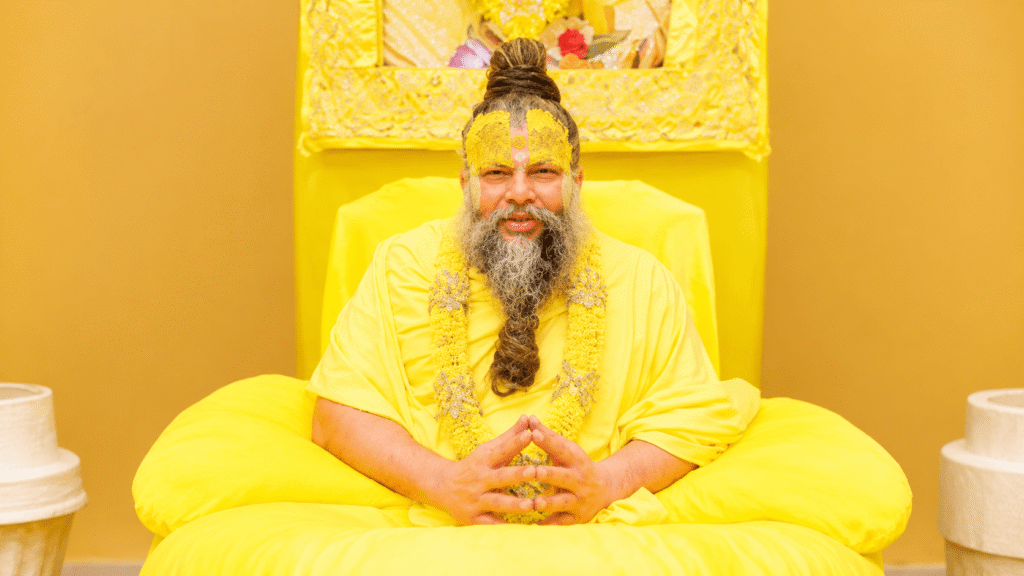
That child’s name was — Aniruddh Kumar Pandey. Today, the world knows him as—Shri Hit Premanand Govind Sharan Ji Maharaj, or simply, Premanand Ji Maharaj.
So, what is his life story, and how did he transform from Aniruddh Kumar Pandey into Shri Premanand Ji Maharaj? We shall explore this in this article. So stay tuned with us until the end.
Premanand Ji Maharaj: Early Life & Family Background
In the year 1971, in a village named Akhari, near the Kanpur district of Uttar Pradesh, an extraordinary child was born into an ordinary Brahmin family. The child was named Aniruddh Kumar Pandey. Coming from a Brahmin family, the atmosphere at home was inherently religious and sacred. His father, Shri Shambhu Pandey, and his mother, Smt. Rama Devi, were both religiously inclined; furthermore, Aniruddh’s own grandfather had embraced the life of renunciation (sannyas).
This had a profound and direct influence on Aniruddh. It was as if the tradition of following the path of righteousness had been passed down to him as an inheritance. Consequently, from a very young age, he developed a deep interest in devotion and spirituality. However, while his parents’ life was devotional and centered on rituals and worship that were enough to bring them a sense of contentment and joy, something else was stirring within Aniruddha – The desire to know and attain the Divine.
By the time it grew ever more intense. And, time and again, a single question would trouble him — If God exists? Then how can one attain Him? Perhaps this very question gradually became the most significant question of his life. And, in many ways, it was this single question that gave both direction and momentum to Aniruddha’s life.
Premanand Ji Maharaj: Renouncing Home and Moving to Kashi
Time passed, and Aniruddha began to grow older. Then, at the age of approximately 13, he made the most difficult decision of his devotional life—to leave home. Just imagine, at an age when a child is barely able to contemplate his own life, Aniruddha made the decision to leave his home behind.
It was around 1985 when he left home with the sole purpose of worshipping the Divine and attaining the Ultimate. Yet, leaving home was not an easy task. A few days later, his elder brother arrived to bring him back, but Aniruddha was not prepared to return. Then, his father himself came to fetch him; but by then, the resolve for renunciation had taken firm root within Aniruddha. He flatly refused to return home.
He set off for Kashi, where he received initiation from his first guru. His guru bestowed upon him a mantra for the worship of Shiva— a Shiva mantra. However, about two years later, his first guru passed away. And then, Aniruddha realized that he stood at a crossroads where he had to discover the path forward for himself.
Premanand Ji Maharaj’s Spiritual Journey In Kashi
In Kashi, he lived a life of rigorous spiritual discipline along the ghats of the Ganges. He had no permanent comforts, no accumulated wealth, and even went without food for days on end. Yet, despite these circumstances, he still felt a sense of satisfaction.
He lived by the banks of the Ganges, engaged in spiritual practice, chanted sacred names, and spent time in the company of saints. Sitting with these saints beneath an old Peepal tree became an essential part of his daily routine.
At that time in Kashi, his devotion was primarily centered upon Lord Shiva. However, he had no inkling or idea that his spiritual journey would eventually shift toward devotion to Radha and Krishna. And this transformation was brought about by an event considered one of Lord Krishna’s most cherished and divine activities — the “Raaslila”.
The Raasleela That Changed His Spiritual Journey
One day, a saint took him to witness a ‘Raaslila’. For the first time in his life, Aniruddha watched a ‘Raaslila,’ and then something occurred that altered the direction of his life. He experienced a profound realization stirred within him. He felt— “This is what my heart has been searching for.” For nearly a month, he watched the ‘Raaslila’ continuously. And gradually, an intense desire awakened within him — to go to Vrindavan.
He explains that his desire to go to Vrindavan was not a personal choice; rather, he perceives it as the grace of Vrindavan and the will of God. According to him, he had never personally chosen to pursue devotion to Radha-Krishna. His spiritual journey had actually begun with devotion to Mahadev (Lord Shiva). Yet, the ‘Raaslila’ he witnessed that day left such a profound impact upon him, and his devotion shifted toward Shriji (Radha Rani) and Vrindavan.
Premanand Ji Maharaj’s Guru & Diksha
Anirudh Kumar Pandey (Premanand Ji Maharaj) then moved to Vrindavan from Kashi. Upon arriving in Vrindavan, he met Shri Hit Gaurangi Sharan Ji Maharaj. From him, he received initiation into the tradition of the ‘Radhavallabh Sampradaya ‘.
The worship tradition of the Radhavallabh Sampradaya is centered on devotion to Shri Radha Rani. This is why the chanting of the name ‘Radha’ and devotion to Shriji are prominent themes in the teachings of Premanand Ji Maharaj. This tradition is believed to have been founded by Shri Hit Harivansh Mahaprabhu.
Following his Diksha in ‘Radhavallabh Sampradaya ‘, Aniruddha Kumar Pandey was given a new name— Premanand Govind Sharan. The famous name with which He is known to the world today.
Radha Naam: The Gateway To Moksha (Liberation)
In the teachings of Premanand Ji Maharaj, one name is heard repeatedly— “The Radha Rani Ji’s name.” According to him, chanting the name ‘Radha’ is the sole means to attain liberation (Moksha) in the Kali Yuga.
For this chanting, there is no need for a specific place, a specific time, or any particular set of circumstances. One can remember the Divine Name while walking, while working, or even during the course of one’s daily life. In other words, devotion is not confined to the temple; it can be practiced amidst the flow of everyday life. A devotee can chant the Divine Name in any situation, even while attending to other duties.
Shri Hit Radha Keli Kunj Ashram: A Hotspot for Satsang, Activities & Ashram
Vrindavan is the permanent residence of Shri Premanand Ji Maharaj, and ‘Shri Hit Radha Keli Kunj‘ is a prominent spiritual center associated with him. Here, ‘satsang’ (spiritual discourse), ‘Radha-nama sankirtan’ (chanting of the name ‘Radha’), and spiritual readings and programs rooted in the ‘Radhavallabh’ tradition are conducted.
It is also from here that he conducts his world-renowned, intimate interactive sessions, through which his teachings reach devotees via ‘satsang ‘. His teachings are not limited to those present before him; rather, through digital ‘satsang’ platforms—such as YouTube, Facebook, and other social media— they reach every corner of the globe.
Premanand Ji Maharaj’s Teachings and Spiritual Philosophy
The core teachings of Premanand Ji Maharaj are as follows:
- Chanting the Divine Name (Nama-japa): In his teachings, chanting the name ‘Radha’
is a primary spiritual practice (‘sadhana’). He emphasizes integrating this chanting into one’s daily life.
- The Path of Love: In his teachings, the foundation of devotion is not fear, but love— love for the Divine and the embodiment of that love in one’s own conduct.
- Controlling the Mind: According to him, viewing the mind as an enemy and fighting against it is not the solution. Instead, it is essential to guide the mind in the right direction. And among the paths he suggests, the chanting of the Divine Name (‘Naam-jap’) is a primary means to provide this direction.
- Householder Life and Devotion: A significant aspect of his teachings is the practice of spiritual discipline (‘sadhana’) while living the life of a householder. Amidst family responsibilities, work, and various duties, one can still remember the Divine.
- Service (Seva): Service should not be performed merely for the sake of show. It should be free from selfishness and ostentation. Selfless service deepens the spirit of devotion.
- Surrender (‘Samarpan’): Surrender does not mean abandoning one’s actions. Rather, it means performing one’s duties while offering the results to the Divine. In other words— it is not about running away from action, but transforming action into a spiritual practice.
Conclsion
The journey of Shri Hit Premanand Govind Sharan Ji Maharaj, from a young boy named Aniruddha Kumar Pandey to a revered spiritual teacher in Vrindavan, is a remarkable story of faith, devotion, and unwavering determination.
His teachings remind us that devotion can become a part of everyday life through Naam-jap, love, selfless service, discipline, and surrender to the Divine.
Whether one follows the path of Shiva or Krishna, the essence of devotion remains the same—the sincere longing to connect with the Supreme.
What do you find most inspiring about the life and teachings of Premanand Ji Maharaj? Share your thoughts in the comments below.
If you enjoyed reading this article, explore more spiritual stories, Hindu traditions, scriptures, temples, and inspiring documentaries on The Hindu Tales.
Stay connected with us, and continue exploring the timeless wisdom and fascinating stories of Sanatan Dharma.
Radhe Radhe!
