

Introduction
Before I start the article, I would like to recite some Sanskrit hymns to draw your attention toward the significance of the term ‘Devi’. It may give you a hint of the importance of the title we are going to discuss.
Here is the first hymn from Durga Saptashati, Devi Suktam…
या देवी सर्वभूतेषु शक्ति-रूपेण संस्थिता। नमस्तस्यै नमस्तस्यै नमस्तस्यै नमो नमः॥
ya devi sarvabhuteshu shakti-rupen sansthita. namastasyai namastasyai namastasyai namo namah॥.”
The goddess who is situated in the form of Shakti in all beings. “Obeisance to her, Obeisance to her, Obeisance to her, Obeisance to her”
Here is another hymn glorifying women in Hinduism from the Manusmriti, Chapter 3, Shloka 56 –
यत्र नार्यस्तु पूज्यन्ते रमन्ते तत्र देवताः।
यत्रैतास्तु न पूज्यन्ते सर्वास्तत्राफलाः क्रियाः॥
yatra naryastu pujyante ramante tatra devtah. yatraitastu na pujyante sarvastatrafalah kriyah॥
Where women are worshipped, gods enjoy them. But where these are not worshipped, all such actions are fruitless.
The above hymn reflects the significance of the term ‘Devi’ as the supreme feminine power, and its correlation with women. In the following few lines, we will attempt to decode its meaning, myths, manifestations, and other aspects in detail, so stay tuned with us.
Definition and Meaning of Devi
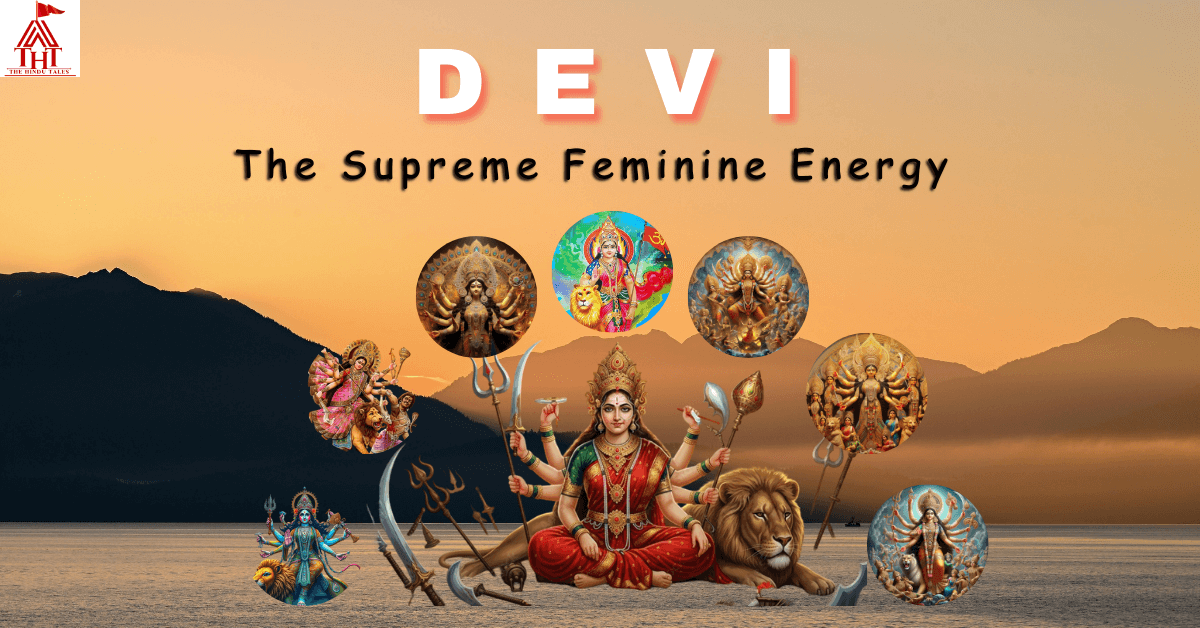
‘Devi Mahatmaya‘ is the holy Hindu Scripture that describes ‘Devi’ as the ‘Supreme feminine divine energy’ behind every creation. She is glorified as ‘Shakti’, ‘Mahashakti‘, ‘Jagatjanni‘, ‘Jagdamba‘, ‘Bhagavati‘, ‘goddess Durga’, ‘Lakshmi’, ‘Saraswati’, ‘Kali’, & the ‘Supreme mother goddess’. She is the embodiment of every feminine creation, womanhood, geographical space (Bharat Maa), and many more. She is the source of energy and the powerhouse of the universe.
The Sanskrit word ‘Devi’ is for ‘the goddess’, which is the antonym of the masculine form ‘Deva’. I can remember my grandfather used to pronounce ‘Deva’ as ‘Devta’ and ‘Devi’ as ‘Devika’. Hence, for easy pronunciation and to abbreviate the length, ‘Deva’ became the short form for ‘Devta’, and ‘Devi’ the short form of ‘Devika’.
Devi’s Manifestation and Forms
In Hinduism, Devi is manifested in many forms. She is embodied in countless forms with countless names. The Hindus manifest her as mother goddess Durga, Kali, Saraswati, Laxmi, etc., goddess of wisdom, goddess of beauty, goddess of love, goddess of compassion, goddess of sacrifice, goddess of war, goddess of music, goddess of place, goddess of clan, goddess of ancestral hierarchy, goddess of wealth, goddess of prosperity, goddess of village, goddess of home, etc. She is the protector, the cosmic force, the creator, the destroyer, the warrior, and in many other roles. Here are a few significant manifestations in which we know her the most.
1. Goddess For Individual
In Hinduism, the concept of deities is the subject of not only universal but also personal beliefs. There is a tradition to worship the goddess who protects a particular people, a particular village, and a particular lineage:
(a) Kul Devi
Kul Devi is the feminine aspect of Kul Devta, who are considered the deities for protecting the clan. In Hindu tradition, each clan has its own Kul Devi. She is worshipped to seek her blessings, for prosperity, and for protection from evil forces. A special worship is performed for her in the family on occasions such as weddings, births, and auspicious ceremonies.
(b) Gram Devi
Gram Devi is the localised form of that universal divine feminine energy that we call Paramshakti or Mahashakti. ‘Gram‘ is the Sanskrit word for ‘village’. Hence, ‘Gram Devi‘ clearly indicates the goddess for protecting the village. She is the ‘guardian deity of the village’.
Unlike today, in ancient Bharat, people used to live in communities. They settle together in one place and worship Gram Devi for collective well-being, fostering unity, and for protection from outer dangers. Worship of Gram Devi is a community-centric practice where communities come together to worship the goddess, seeking her blessings for good crop harvesting, receiving necessary resources for sustaining life in the village.
(c) Isht Devi
The Sanskrit word ‘isht’ means ‘Desired’, or ‘wished’. Hence, the ‘Isht Devi’ refers to the goddess for personal growth and devotion. In Hinduism, we have ‘33 Koti Devta’. It means that it’s up to us to choose our personal god or goddess. We can have different Isht Devi or Isht Dev, for which we have an inclination or with whom we feel a connection.
2. Cosmic Goddess
Cosmic goddesses are the divine feminine aspects of the supreme cosmic energy. They are considered the energy behind every other creation. She is the preserving force for the universe and also responsible for its destruction. Below are the names of some powerful cosmic goddesses with short introductions about them:
(a) Adi Shakti / Adi Parashakti
The Sanskrit word ‘Adi’ refers to ‘beginning’, and the ‘Shakti’ to ‘Power’. Hence, Adi Shakti is that feminine power in the universe that has existed since the beginning of the universe. In Hinduism, we consider it as the supreme feminine energy and name her as ‘Adi Shakti’ or ‘Adi Parashakti’.
(b) Laxmi
Goddess Laxmi is considered the goddess of wealth & prosperity. She is the consort of Lord Vishnu and therefore regarded as one among the ‘Tridevi’.
(c) Saraswati
Goddess Saraswati is considered the goddess of knowledge & wisdom. She is the consort of Lord Brahma and therefore regarded as one among the ‘Tridevi’.
(d) Parvati
Goddess Parvati is considered the goddess of power. She is the consort of Lord Shiva and therefore regarded as one among the ‘Tridevi’.
3. Mother Goddess
In Hinduism, goddesses Durga, Kali, etc., are acknowledged for their motherly characteristics. We worship them to seek her motherly love and blessings. We see in them the presence of a mother; therefore, we connect with them as a child. We consider Goddess Durga, Goddess Kali, Goddess Santoshi, Goddess Chhath Maa, and other regional goddesses as our divine mother who protects us always.
(a) Goddess Durga
The name Durga is derived from the Sanskrit word ‘Durgam’ (Dur (difficult)+ Gam (to go)). It is composed of ‘Durg’, which means ‘fortress’. It represents her as the goddess who is “impassable,” “invincible,” or “unassailable.” She helps her devotees in overcoming all difficulties, crises, and obstacles. Hence, we Hindus recognize her as a fierce protector and reliever of all problems.
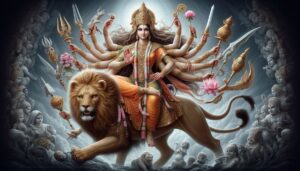
She is the primary goddess of Hindus, who is famously revered as Navdurga, Jagatjanni, Jagdamba, Mahishasurmardini, etc. She appeared to slay the buffalo demon king Mahishasur. Thus, called ‘Mahishasurmardini (The Slayer of Mahishasur)’. It is believed that reciting the 32 names of Maa Durga relieves one from troubles and difficulties in life. Goddess Durga is manifested in nine other forms that you can read about in detail in the book – Goddess Durga: The Ultimate Mother (A Comprehensive Guide to Nine Manifestations).
- Goddess Shailaputri
- Goddess Brahamacharini
- Goddess Chandraghanta
- Goddess Kushmanda
- Goddess Skandamata
- Goddess Katyayani
- Goddess Kalratri
- Goddess Mahagauri
- Goddess Siddhidatri
(b) Goddess Kali
The Sanskrit word ‘Kali’ derives from the word ‘Kaal’, which is used in Indian scriptures to refer to both ‘time’ and ‘misfortune’. The term ‘Kali‘ is also used to represent the feminine version of the word ‘Black’, so the name ‘Kali‘ can be interpreted as “the goddess whose color is black.” Kali also indicates that she is the ruler of time, and that all events, both happenings and mishappenings, are under her control. She is the fierce incarnation of Goddess Durga Maa, who appeared to represent her anger.
(c) Goddess Santoshi Maa
‘Santosh‘ is the Sanskrit word for ‘Satisfaction’. Hence, she is considered the ‘goddess of Satisfaction‘. Devotees worship her on the specific day of ‘Friday’, and worshipping her on the 16 consecutive Fridays provides desired results. She accepts simple offerings such as Gram (Chana), Jaggery (Gud), and Khaja (an Indian deep-fried pastry-like snack).
(d) Goddess Chhathi Maa
The word ‘Chhath’ originated with the Sanskrit word ‘Shasht’, which means ‘Six’. ‘Chhath Puja’ is the Hindu festival dedicated to ‘Goddess Chhathi Maa’, which is celebrated on the ‘Sixth Day’ of ‘Kartik Mas’ according to the Hindu calendar. She is the sister of the god Sun and therefore also regarded as ‘Usha Devi’. Her worship is associated with the ‘worship of nature (Prakriti Puja),’ and therefore she is regarded as the mother goddess for Hindus. Her worship is popular in the North region of India – Bihar, Jharkhand, Uttar Pradesh, and Delhi. While the ‘Chhath Puja’ was specially originated in ‘Bihar’. Devotees worship the goddess ‘Chhathi Maa’ for the well-being of their family, especially children in the family.
4. Devi as Universal Mother
In Hinduism, there is the concept of Adi Shakti or Adi Parashakti, who is none other than the source of all energies prevailing in the universe. Therefore, she is also regarded with terms like Mahashakti, Jagatjanni, Jagdamba, Bhagavati, etc. We Hindus consider her as the ‘Universal Mother’, as she is the mother of all living, non-living, creatures, forces, etc. in this universe. Goddess Durga, Goddess Kali, Goddess Parvati, Goddess Chhathi Maa, Goddess Laxmi, etc., are all just the manifestations of her who emerged to balance the existence of good and bad energies.
5. Devi As Specific
In Hinduism, some goddesses are worshipped for the fulfillment of specific purposes. While they are all the embodiment of the same divine energy, their relevance is limited to a few specific boons:
(a) Annapurna Devi: The goddess of Food
The Sanskrit word ‘Anna’ refers to the ‘Food’ while ‘Purna’ to ‘the Provider’. Hence, the Annapurna Devi is the goddess for providing food and nourishment. She is one of the manifestations of the goddess Parvati. In Hinduism, food is considered equivalent to ‘Brahma‘- the supreme deity. ‘Anam Brahma’ is the Sanskrit verse which means ‘Food is Brahma’. Hence, if you are receiving food, it is a blessing from the Almighty. Therefore, we Hindus worship ‘Annapurna Devi’ to seek her blessings in getting food and nourishment.
In Taitriya Upnishad, it is said that –
“All beings on earth are born from food; they live by food; and ultimately, they return to food. Food is undoubtedly the eldest of all beings; therefore, it is called the remedy for all. Those who consider food as Brahman (the ultimate reality) obtain all food; because food is the eldest of all beings, it is called the remedy for all. Beings are born from food, and having been born, they grow by food. It is their nourishment, and it consumes beings; therefore, it is called food.”
(b) Bhu Devi: The goddess of the Earth
‘Bhu’ is the Sanskrit abbreviated word for ‘Bhumi’, which means ‘Earth’. Therefore, ‘Bhu Devi’ is the goddess of the ‘Earth’. Apart from this, she is also known by her other names, such as ‘Bhumi Devi’, ‘Prithvi Devi’, ‘Vasudha’, ‘Vasundhara’, ‘Urvi’, ‘Ira’, ‘Kasyapi’, etc. ‘Bhu Devi’ is considered one of the manifestations of ‘goddess Laxmi‘ in association with her ability to provide wealth, fertility, and prosperity.
We Hindus worship ‘Bhu Devi’ because she is the source of Life and Sustenance. She provides life resources, including crops, water, minerals, and vegetation, which are necessary to sustain life on this Earth.
In the Atharvaveda, the Bhumisukta (or Prithivi Sukta) is the first sukta of the twelfth khanda, dedicated entirely to praising Mother Earth. Read one of the verses from Atharvaveda, I am putting here –
गिरयस्ते पर्वता हिमवन्तोऽरण्यं ते पृथिवि स्योनमस्तु ।
बभ्रुं कृष्णां रोहिणीं विश्वरूपां ध्रुवां भूमिं पृथिवीमिन्द्रगुप्ताम् ।
अजीतेऽहतो अक्षतोऽध्यष्ठां पृथिवीमहम् |
“O (Mother) Earth, May the mountains, the Himalayas, the forests, and the earth be your source of strength. I worship the beaver, the black woman, the constellation Rohiṇī, the form of the universe, the poles of the earth, and the earth protected by Indra. Unconquered, wounded, and unharmed, I rule the earth.”
(c) Bharat Maa: The goddess of the Bharat Bhumi
Bharat, that is India, is the land of Rishis, Saints, Cultural Values deeply rooted in Sanatan Dharma, and Vedic Civilization. The very name ‘Bharat’ for this land is inherited from the great king ‘Bharat’ of this land. The followers of Sanatan are Hindus who worship this land as the mother goddess and refer to her as ‘Bharat Maa’.
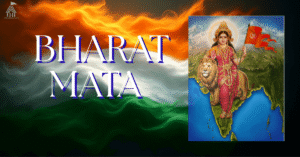
She is personified as the divine figure wrapped in a saffron-colored Sari, accompanied by a Lion. She holds a saffron-colored flag representing the land of Bharat and its people (Hindus). Because Bharat is the land of Hindus, and the saffron color is the symbol of austerity and courage in Hinduism, she is represented in saffron color. She is believed to be the protector of this land in the same way the ‘Gram Devi’ protects the village.
Devi As General – Hindu Women As Embodiment of Shakti
In Hindu philosophy, every woman is considered a living embodiment of Devi. Her identity is not seen merely in physical or social terms, but in the deeper spiritual truth that she embodies Shakti—the dynamic, creative force of the universe. She is regarded as Griha-Lakshmi, Annapurna, Shakti-swaroopa, and with many other divine titles.
- Hindu women are regarded as Griha-Lakshmi – the embodiment of goddess Laxmi in the home because her presence is believed to bring auspiciousness, prosperity, emotional warmth, stability, grace, and flourishing relationships.
- Hindu women are regarded as the Annapurna, the embodiment of the goddess of Food, because she carries the responsibility of physical and emotional well-being in the house.
- Hindu women are considered as Shakti-Swaroopa, the embodiment of Durga and Kali, because of their strength, courage, and ability to protect the family.
- Hindu women are regarded as Janni (Life-giver) and the goddess of Compassion & Love because their heart expresses karuna (compassion) and sneha (affection) in the best possible form.
Importance of Devi worship in Hinduism
In Hinduism, Devi is often regarded as the source of energy, the provider, the giver, the creator, and the originator. Take for example, when the land is fertile enough to produce grain to feed us, we Hindus refer to her as ‘Bhoo Devi’ (the goddess of Earth or mother earth), when a country or geographical boundary is enough to provide shelter, peaceful life, and the environment to flourish, we refer to her as ‘Matribhumi’ (the mother land, Bharat Maa), when a woman is enough to give birth & raise a child, we refer to her as ‘Maa’ (the embodiment of goddess on Earth).
When a divine aspect of the supreme feminine energy is enough to protect us from evils, we refer to her as ‘Devi Maa’ or ‘Bhagavati Maa’ (Mother goddesss or the ultimate mother), when the very same Devi is enough to protect our Kul (Clan)’ or ancestral hierarchy, we refer to her as ‘Kul Devi’ (the goddess for clan),; When the same divine appearts to protect our place, village, or city, we refer to her as ‘Gram Devi’ (the goddess of village).
Conclusion
We see that the ‘Devi worship’ in Hinduism is not bound to a specific aspect but walks into every aspect of life. We Hindus are grateful for everything we receive from nature, and therefore, we worship many goddesses for various specific boons, needs, and purposes. It helps us to connect with the supreme cosmic energy in different ways through different Devi forms.
Frequently Asked Questions (FAQs)
Q1. Who is Devi?
Ans. In Hinduism, Devi is the divine, supreme feminine energy who is behind every creation in this universe. She is omnipotent, omnipresent, and resides within all of us in the form of consciousness and life energy.
Q2. How many forms of Devi are there?
Ans. Devi is one, and we refer to her as Adi Shakti, Adi Parashakti, Mahashakti, Jagatjanni, Jagdamba, Mahamaya, Mahadevi, and with a thousand other names. But she has countless forms in various categories, such as Navdurga (A group of Nine forms of goddess Durga), Tridevi (A group of Three Divine Supreme Feminine Energies), Mahavidya Devi (A group of Ten Mahavidya Devis), Gram Devi (Regional goddess), Isht Devi (Desired Deities), Kuldevi (goddess for Lineage), etc.
